
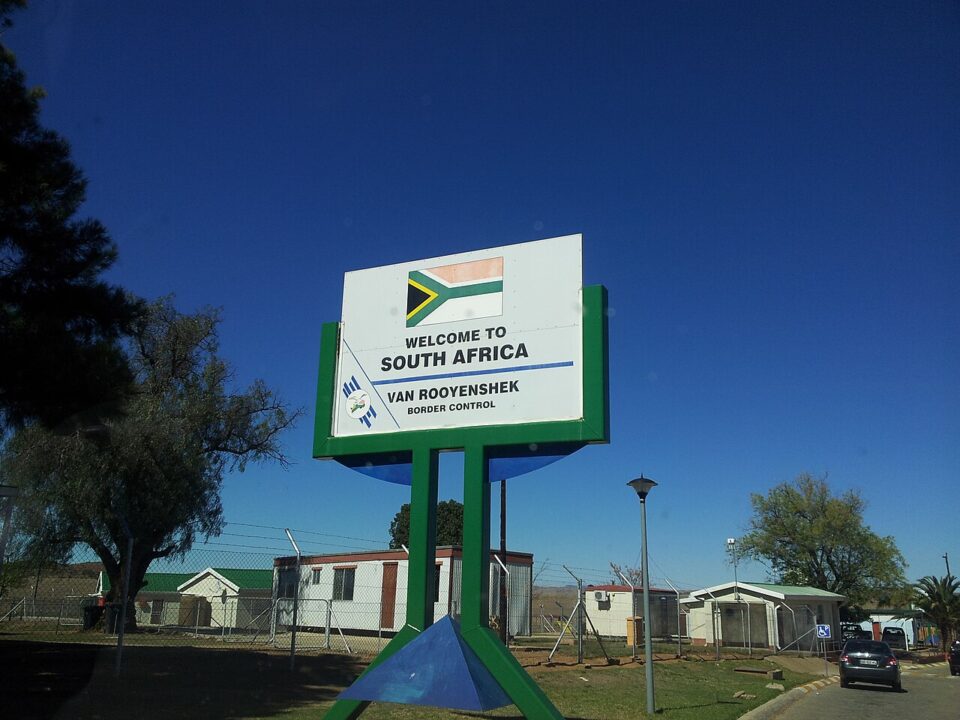
…over 5 000 Basotho intercepted for entering SA illegally
Mathatisi Sebusi
VAN Rooyens Gate border post is now the leading hotspot for illegal migration between South Africa and Lesotho after recent improved compliance at both the Maseru and Ficksburg border posts.
This was revealed by South Africa’s Free State Regional Immigration Manager, Thabo Nkhoma, who told the Lesotho Times in a recent interview that more than 4000 undocumented Basotho were intercepted at the Van Rooyens Gate port of entry — the official gateway into South Africa via Mafeteng.
“In total, over 5000 undocumented Basotho were intercepted across all Free State–Lesotho border areas, with more than 4000 of these cases recorded at Van Rooyens Gate alone,” Mr Nkhoma said.
He said the majority of undocumented migrants were deported back to Lesotho, while more than 100 individuals were arrested for various immigration-related offences, including possession of fraudulent documents, illegal entry, and unlawful residence in South Africa. Those arrested, he said, were charged and subjected to South Africa’s criminal justice processes.
Mr Nkhoma also said about 200 Basotho were declared undesirable for overstaying in South Africa.
“According to interim traveller statistics from 10 December 2025 to 7 January 2026, about 100 000 travellers passed through Caledonspoort Border Gate (Butha-Buthe), 60 000 through Van Rooyens Gate, 250 000 through Ficksburg (Maputsoe), and 255 000 through Maseru Bridge,” he said.
While challenges remain at the Van Rooyens Gate, Mr Nkhoma said there was a notable improvement in compliance at both Maseru and Ficksburg border posts.
“This improvement is a result of intensified border law enforcement operations at these ports of entry,” he said.
He explained that the Border Management Authority (BMA) has observed a shift in illegal migration patterns, with most incidents now occurring at or near Van Rooyens Gate.
“In response, intensified border law enforcement activities, supported by drone operations, have been implemented and will continue indefinitely at and around Van Rooyens Gate,” Mr Nkhoma said.
He stressed that the BMA, working with other state agencies such as the South African National Defence Force, the South African Police Service, and the South African Revenue Service, will not tolerate lawlessness at the country’s ports of entry.
“The BMA will take all necessary measures to address criminality at all ports of entry, with special focus on Van Rooyens Gate and Tele Bridge (Quthing),” he said.
Mr Nkhoma further emphasised that those who violate South Africa’s immigration laws will be dealt with harshly in accordance with legislation governing the movement of people and goods across international borders.
He also said joint special border law enforcement operations would be introduced to dismantle syndicates involved in smuggling.
Cases of illegal migration and human trafficking occurring through Van Rooyens Gate border post were confirmed by Migrant Workers Association of Lesotho (MWA-Ls) Director, Lerato Nkhetše.
Mr Nkhetše told the Sunday Express on Friday that unemployment and poverty in Lesotho remained the main push factors driving Basotho to migrate, whether legally or illegally.
He explained that another contributing factor was the widespread assumption that South Africa offers abundant job opportunities, despite the country also facing high unemployment levels.
“People leave the country with these assumptions, only to be disappointed when they arrive in South Africa and find that there are no jobs,” Nkhetše said.
He also said lack of transparency in job distribution within Lesotho has resulted in many graduates leaving the country in search of opportunities elsewhere, often without applying for available positions at home.
Unequal distribution of national resources, which does not adequately benefit Basotho, has led many to believe that their only chance of survival lies in migrating to South Africa, he said.
“Social media also plays a significant role in recruiting Basotho into human trafficking by promising well-paying jobs. We have received many cases of Basotho who left the country under the promise of employment, only to become victims of human trafficking,” he said.
Mr Nkhetše also noted that the chaotic issuance of passports in Lesotho has contributed to illegal migration.
“We describe the passport distribution system as unsystematic because we have learned that some people who applied for passports around October 2025 have already received them, while others who applied as early as June the same year are still waiting,” he explained.
“These discrepancies in passport issuance force some Basotho to migrate illegally, often resulting in interception or, in worse cases, arrest.”
Mr Nkhetše said the solution to these migration challenges lies in dialogue between Lesotho and South Africa to improve the facilitation of movement of people and goods.
He further suggested that the two countries should review migration models and ensure that work permit applications become more accessible.
He said the majority of Basotho wish to migrate to South Africa legally, but difficulties in accessing the relevant documentation remain a major barrier.
Efforts to obtain statistics on trafficking in persons and illegal migration from the Lesotho Mounted Police Service (LMPS) were unsuccessful.
Police spokesperson, Superintendent Mpiti Mopeli, had promised to consult the relevant office and provide the Lesotho Times with the information, but did not respond to follow-up calls.
