
…fall prey to mobile money scams in Maputsoe
Kabelo Masoabi
IN Maputsoe, Lesotho’s second-largest town, elderly residents are increasingly falling victim to sophisticated mobile money scams and ruthless loan sharks, leaving many destitute and indebted just a few days after receiving their monthly pensions.
Police in the area have said scores of older people are conned every month, often immediately after collecting their government old-age pensions of M950. The crimes, they warn, are becoming more organised and deliberately target pensioners who are unfamiliar with mobile money technology.
One such victim is 74-year-old ’Matsekiso Monatsi, whose pension vanished in minutes.
While in town, she was approached by a woman who pretended to “help” her save money using a mobile phone. The stranger asked Ms Monatsi to hand over M900 in cash, promising to send the same amount to her mobile money account in return.
Believing the transaction to be safe, Ms Monatsi agreed and gave the money to the stranger. Moments later, she received what appeared to be a confirmation message indicating that M900 had been deposited into her account.
It was only the following day, when she attempted to withdraw money to buy a bag of maize meal, that she discovered her account balance was just over M35. The message she had received was fake.
“I did not understand what had happened. I trusted the message I received,” Ms Monatsi said.
Senior citizens targeted
According to Sub-Inspector Khahliso Latela of the Crime Prevention Unit in Maputsoe, Ms Monatsi’s ordeal is far from unique. Sub-Insp Latela said that in 2025 alone, at least 47 elderly women in Maputsoe were defrauded through fake mobile money messages.
A further 21 pensioners fell prey to loan sharks who continued charging exorbitant interest even after borrowers failed to settle their debts.
“These criminals know exactly when pensions are paid. They wait for elderly people in town, pretend to help them, and then steal everything,” Sub-Insp Latela said, adding that no arrests have yet been made.
Lesotho operates a universal, non-contributory old-age pension scheme for citizens aged 70 and above. Introduced in 2004, the programme was designed to improve the quality of life of the country’s elderly population. As of fiscal year 2024/2025, the monthly pension stands at M950.
There was no increment in the 2025/26 financial year, leading to disappointment among recipients who say the amount barely meets basic needs. Although relatively small, the pension remains a crucial and reliable source of income for many households, often supporting entire families, including the education of grandchildren, while strengthening the financial decision-making power of the elderly.
In recent years, the Ministry of Gender, Youth, Sports, Arts, Culture and Social Development, through the Department of Social Development, transitioned to mobile payments to improve safety and ensure faster delivery of monthly pensions.
More than 40 000 elderly people, about 53 percent of all pension beneficiaries, now receive their grants electronically. The majority access their funds through mobile money platforms such as M-Pesa and EcoCash.
While the move has improved efficiency, authorities warn that it has also exposed pensioners to cyber criminals.
Police are urging families, community leaders and mobile money service providers to intensify education efforts aimed at older people, particularly around common scams. Pensioners are encouraged not to share money, personal identification numbers (PINs) or sensitive personal information with strangers.
“Without awareness and protection, our elderly will continue to suffer at the hands of criminals who see their pension as easy prey,” Sub-Insp Latela warned.
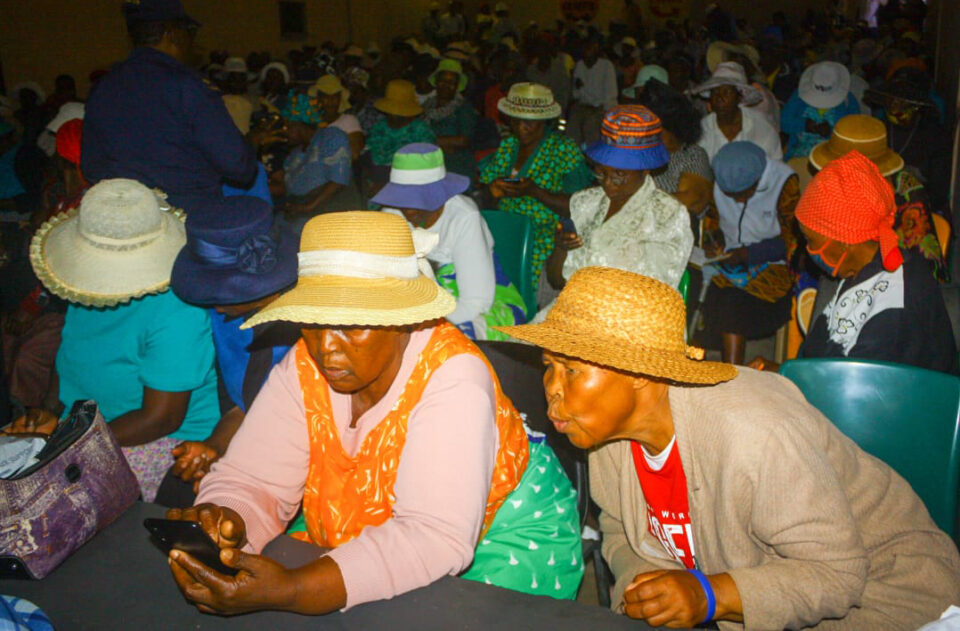
She said that last Saturday, police convened a conference attended by more than 400 elderly residents of Maputsoe to raise awareness about their rights and the vital role they can play in promoting safety and accountability within their communities.
“The forum emphasised the importance of reporting suspicious activities, offenders and incidents of abuse,” she said.
Sub-Insp Latela added that elderly people are often daily witnesses to events within their communities but remain silent due to intimidation or oppression by other community members.
“Our objective is to foster an open and trusting relationship with them, empowering them to speak out and to seek assistance from the police or relevant authorities at any time without fear.”
Post festive debts
January has brought distress rather than relief to many elderly pensioners following what appeared to be a blessing in December — a double pension payment also covering the month of January.
While the two months’ pay was intended to cushion pensioners during the festive season, this has, instead, plunged many into deeper financial trouble.
Jomane Barete (86), a resident of Ha Barete in Maputsoe, expressed grave concern, warning that many pensioners are now at risk of drowning in exorbitant debts.
He explained that the excitement of receiving a double payment, combined with the joy of hosting visiting children and grandchildren, led many pensioners to overspend.
“Many older people will struggle to pay their loan interest this month after overspending during the festive season. Some were so delighted to see their children and grandchildren that they spent beyond their means in celebration. I fear loan sharks will take advantage of this situation and exploit vulnerable pensioners by doubling the interest,” Mr Barete said.
The former police officer noted that informal money lenders, commonly known as loan sharks, are notorious for exploiting vulnerable pensioners, particularly during financially strained months such as January.
Failure to repay loans on time often results in inflated interest rates, seizure of bank cards, or prolonged cycles of debt.
Adding to the elderly’s woes is a growing concern over financial abuse within families. An elderly woman, ’Maseipone Khomare (72), revealed that some grandchildren unlawfully steal money from their grandparents’ mobile phones by guessing PINs, which are often set as birth years.
“Some fall prey after asking for assistance from their children and grandchildren to withdraw money. They give their PINs, trusting they will not be robbed because they trust them the most. Instead, the children take the money and buy alcohol and other unimportant items, leaving the entire family in dire starvation,” Ms Khomare lamented.
Community members have called for urgent intervention from social workers, financial institutions and law enforcement agencies. They are urging the introduction of expanded financial literacy programmes for pensioners, stronger protection against predatory lending, and sustained awareness campaigns on safeguarding personal banking information.
“As January begins, the struggles of many older people remind us of a hard truth. Trust in family, kindness during the holidays and money worries can come together and cause serious harm,” said concerned citizen, Solomon Chapi.
“Protecting pensioners from being taken advantage of by strangers or even by family members is a responsibility society must take seriously.”
