
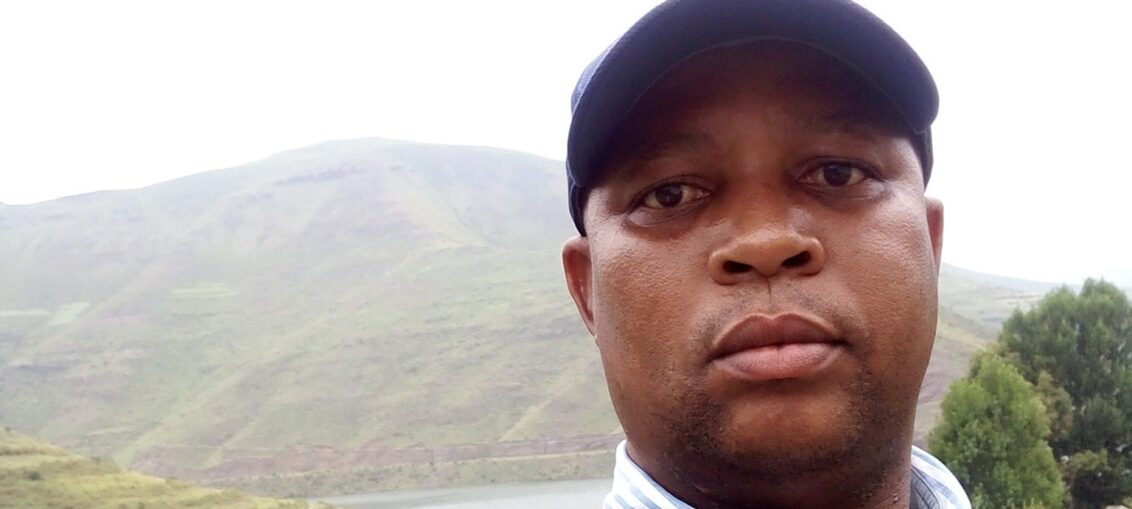
Lesotho’s government has finally perfected the art of national foolishness. Not content with losing control over crime, unemployment, and the general collapse of the state, our brilliant authorities have now chosen a new enemy of the people: a man whose biggest crime is believing his own hallucinations.
Enter Dr Tsepo Lipholo — the Basotho Covenant Movement leader with an academic title as contested as his political ideas. This is the man who flew to America, marched himself into the UN and the Donald Trump orbit, and demanded that the mighty Republic of South Africa kindly return the Free State, Gauteng, parts of KZN, and the Eastern Cape to little Lesotho.
Yes, dear reader.
A whole grown man.
Went to the world’s superpower.
To reclaim Welkom and Umlazi on our behalf.
If there were nominations for “Most Entertaining Delusion in Southern Africa,” Lipholo would win by a landslide.
And yet, instead of laughing and moving on, our government has chosen to persecute this man as though he were leading a global terror syndicate.
For two years now, Lipholo has been locked up like a dangerous warlord — hands and feet chained — allegedly for training mercenaries on some South African farm. Even the South African authorities, who are very thorough when armed Basotho appear anywhere near their fences, have dismissed the whole “mercenary training” allegation as pure fiction.
But Lesotho, ah Lesotho…
We cling to a hoax the way a drunk clings to a last beer.
Persecuting the harmless, ignoring the dangerous
While the state dithers, Lipholo rots in prison — literally gasping for breath, surviving near-death experiences only because double-murder convict Lehlohonolo Scott banged on a door and summoned help.
Let that sink in:
In Lesotho, it takes a convicted serial killer to save a political prisoner from the neglect of the state.
Scott might as well apply for a humanitarian medal.
Meanwhile, real gangsters roam free.
Murderers stroll casually through villages.
Extortionists run neighbourhoods like personal fiefdoms.
Firearms flow through borders like water.
But our brave government?
Ah yes, they have chosen to wage war against a lone man whose political programme is indistinguishable from a psychiatric case study.
A trial without a docket, a case without evidence
Lipholo has repeatedly told the courts that he is ready for trial — but the Crown, which allegedly completed investigations ages ago, still cannot produce a docket. The man’s health is failing; the prison clinic has become a revolving door of diagnoses; and still the government drags its feet.
If the prosecution moves any slower, archaeologists will have to excavate the docket in the year 3050.
Release the man and refocus on reality
Let’s be clear:
South Africa is never — not today, not tomorrow, not in the next thousand years — going to hand over its provinces to Lesotho.
Even a toddler knows this.
The only people who don’t seem to know it are:
1. Dr Tsepo Lipholo
2. The Lesotho government, which apparently believes his fantasy so much that it sees him as a national threat
He is not a threat.
He is a distraction.
And a tragic one at that — a sick, deteriorating man chained hand and foot because the state wants to demonstrate strength in all the wrong places.
Lesotho does not have the luxury of indulging in political theatre.
Not when:
- the murder rate is volcanic,
- the economy is comatose,
- youth unemployment is a national trauma,
- corruption is a generational inheritance,
- and governance resembles an unending circus.
Why waste time persecuting a deluded activist who thinks Maseru will one day annex Johannesburg?
Free him, focus on real criminals
Scrutator’s advice — though government never listens — is simple:
Release Dr Lipholo.
Give him medical care.
Let him pursue his imaginary map of “Greater Lesotho” from the comfort of his living room.
Then take all the taxpayer money currently being wasted on this hoax prosecution and invest it in:
- proper policing,
- crime intelligence,
- border control thatactually works,
- and an economy that produces something other than empty speeches.
Until then, persecuting Tsepo Lipholo is nothing but evidence that Lesotho has perfected its favourite pastime:
acting tough against the harmless while surrendering to the truly dangerous.
This is a circus the country can truly not afford to continue experiencing. The government needs to deal with the ubiquitous real problems this country continues to grapple with. It must set Lipholo free and let him continue with his hallucinations of creating a greater Lesotho (incorporating Welkom and Bloemfontein) from the comfort of his Khubetsoana.
After all, being a dreamer and being stupid are not crimes recognised in both criminal and common law?
Finally, Justice for Joki — and May Judge Mokoko Sharpen the Axe Further
Lesotho, for once, can exhale. After months of public anxiety, High Court Judge Tšeliso Mokoko has finally delivered the kind of judgment this country has long needed but rarely sees: clear, clinical, fearless — and devastating.
At long last, the murderers of journalist Ralikonelo “Leqhashasha” Joki have been convicted.
And not just for Joki’s execution, but also for an additional pair of murders committed in the same blood-soaked week. A triple-murder spree brought to an end by a judge who refused to bow to intimidation, political noise, or legal theatrics.
In a country where everyone talks tough about crime but trembles when it comes to confronting real killers, Justice Mokoko stood firm.
Scrutator salutes him.
And equally, Scrutator salutes Advocate Christopher Lephuthing — a prosecutor who worked like a man possessed, calling witnesses, piecing evidence, ripping through lies, and stitching together a case that has finally given the nation some hope that justice is not a permanently missing person in Lesotho.
Bravo, prosecutor. Bravo, judge
This is what the rule of law looks like.
Killers of journalists have no place in any democracy
Let’s be brutally honest: killing a journalist is not just murder — it is an attack on the nation’s voice, the public’s right to know, and democracy itself. It is an attempt to silence scrutiny and bury truth under bullets.
Those who assassinated Joki didn’t just kill a man.
They tried to terrorise the entire media fraternity.
They tried to make Lesotho a graveyard for press freedom.
Not on Judge Mokoko’s watch.
By convicting these men — Tlelase, Liphoto, Phakoe, and Moabi on the related murders — the court has finally told Lesotho’s killers that the microphone is not a coffin and journalists are not prey.
Now the only thing remaining is the appropriate sentence.
Scrutator’s humble request: Bring back the ultimate deterrent
Scrutator will say what many whisper:
If there was ever a case deserving the death penalty — this is it.
Spare the soft talk about rehabilitation.
Spare the academic lectures about “restorative justice.”
These were not confused youngsters.
These were cold, calculated killers who:
- hunted a journalist,
- plotted his murder openly,
- executed him without mercy,
- and then went on to kill two more people days later.
They are beyond redemption.
They must be permanently removed from society.
If the law still allows it (and yes it does), Judge Mokoko should sharpen the axe.
We are tired of murderers treating prisons as training camps.
We are tired of seeing them strolling around, boasting, threatening witnesses, and returning to kill again.
Even the likes of Tlali Kamoli, whose own judgment now rests with Justice Hungwe, must be dealt with harshly.
The days of mass murderers hiding behind politics should be buried alongside their victims.
A rare moment of justice — let it set a precedent
This ruling is a triumph — not just for Joki’s family, not just for the media fraternity, but for every Mosotho who is sick and tired of living in a criminal paradise pretending to be a country.
For years we have watched judges tiptoe barefoot around murder cases as though afraid of hurting the killers’ feelings.
Judge Mokoko has broken that curse.
Now, Scrutator urges him:
Finish the job. Sentence them as the law permits — firmly, decisively, unapologetically.
Let Lesotho’s killers know that the age of impunity is ending.
And let journalists know that their voices, though often ignored, will not be silenced by bullets.
Today, justice has spoken.
Tomorrow, may it thunder.
Ache!!!
