

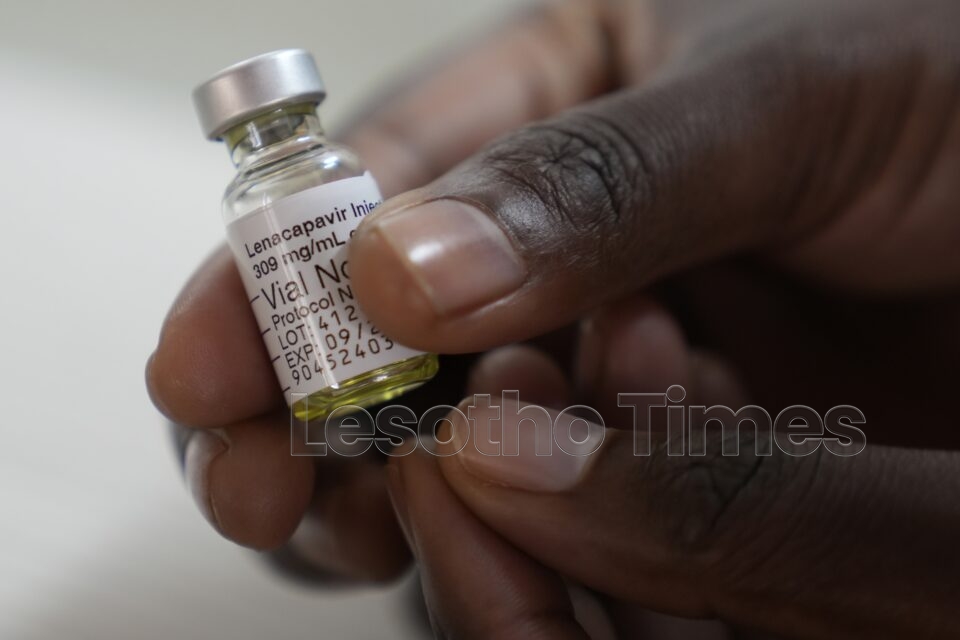
…as the US, govt roll out new treatment drug
Mathatisi Sebusi
LESOTHO is among the countries selected to roll out a groundbreaking HIV prevention initiative.
Supported by the United States, the government is set to introduce a new long-acting injectable drug, lenacapavir, aimed at reducing new infections, particularly among pregnant and breastfeeding mothers.
The initiative, launched by the US Department of State through the President’s Emergency Plan for AIDS Relief (PEPFAR), will bring US-based Gilead Sciences’ innovative drug to countries with the highest HIV burden.
Lenacapavir is an HIV capsid inhibitor used both for treatment in adults with heavily multi-drug-resistant HIV and for HIV prevention (PrEP) in adults and certain adolescents.
It works by disrupting HIV replication at multiple stages of the virus’s lifecycle.
While lenacapavir does not cure HIV, it can reduce the viral load, delay AIDS-related conditions, and strengthen the immune system.
Lesotho has become one of the first countries globally to access lenacapavir through PEPFAR, marking a major milestone in the fight against HIV. Experts believe that the rollout of this drug could save hundreds of thousands of lives worldwide and represents a key step toward ending mother-to-child transmission of HIV in the region.
With coordinated efforts between the US government, Gilead Sciences, the Global Fund, and Lesotho’s health authorities, lenacapavir is expected to significantly reduce new HIV infections while improving convenience and reducing treatment costs for patients.
This collaboration reflects an unprecedented level of international support for innovative HIV prevention strategies in worst affected countries.
The drug, administered twice a year, has demonstrated remarkable effectiveness in clinical trials, keeping more than 99% of participants HIV-negative.
The Public Affairs Officer at the US Embassy Maseru, Jess Tesoriero, told the Lesotho Times that Lesotho is now positioned to become one of the first countries globally to access lenacapavir through PEPFAR, marking a major milestone in the fight against HIV.
“We are very pleased to announce that Lesotho will be among the first countries to be provided with lenacapavir by PEPFAR. We are working closely with the government of the Kingdom of Lesotho and providers to develop a rollout plan,” Ms Tesoriero said.
According to Ms Tesoriero, PEPFAR is prioritising countries based on the burden of HIV and the strength of their healthcare infrastructure to ensure effective distribution.
“This rollout will focus on prioritising distribution to pregnant and breastfeeding mothers — helping Lesotho move toward eliminating HIV infections in newborn children. We are excited to work with partners to help Lesotho on this exciting new PEPFAR initiative and on funding HIV/AIDS care and treatment services for all of Lesotho’s 10 districts,” she said.
She emphasised that the initiative builds on “the very significant progress we have made together to reduce the number of new HIV/AIDS infections”.
Lenacapavir’s twice-yearly delivery method improves convenience and adherence, reducing treatment costs and ensuring fewer HIV transmissions.
The convenience of long-acting injectables like lenacapavir makes them highly preferred among patients, while its cost-efficiency allows healthcare systems to reach more people with fewer resources.
The US government is making a pre-market commitment to purchase the drug from Gilead Sciences, ensuring early and sustained availability in Lesotho.
Gilead has agreed to supply the medication at cost and to provide their intellectual property to generic manufacturers, allowing production to be scaled up and future prices to remain affordable.
The Chairman and Chief Executive Officer of Gilead Sciences, Daniel O’Day, said: “Lenacapavir is one of the most important scientific breakthroughs of our time and the result of nearly two decades of work by Gilead scientists. We are providing the medicine at no profit in this partnership so we can support the US government in delivering life-saving programmes where the need is most urgent.”
The Global Fund is also co-funding the initiative, helping expand access to lenacapavir in additional countries.
Its Executive Director, Peter Sands, said: “Accelerating access to innovations like lenacapavir is imperative if we are to turn the tide against HIV. By targeting where lenacapavir can have the greatest effect, and working with the US and Gilead, we can help countries integrate it efficiently into their HIV prevention programmes — reducing new infections and enabling them to move more quickly along the pathway toward transition and self-reliance.”
The twice-yearly dosing schedule of lenacapavir is designed to improve patient adherence and reduce the frequency of clinic visits, making it easier for health systems to deliver the medication on scale. In addition, the medication has been clinically proven to be extremely effective, ensuring that individuals on lenacapavir remain protected from HIV over extended periods.
“This US commitment exemplifies Secretary Rubio’s America First life-saving assistance agenda: it champions American innovation, advances the Administration’s goal of ending mother-to-child transmission of HIV, and will serve as an important catalyst for greater global and private sector investment in access to this groundbreaking medication,” said Jeremy Lewin, Senior Official for Foreign Assistance, Humanitarian Affairs, and Religious Freedom.
These developments were confirmed by the Principal Secretary in Lesotho’s Ministry of Health, ‘Maneo Ntene, who said preparations were at an advanced stage and that the drug had already been ordered.
“We as a country prefer youth to abstain from sex as a measure to prevent the spread of HIV, but now that we have failed in that aspect, we will administer lenacapavir,” Ms Ntene said.
Meanwhile, the Ministry of Health’s HIV and AIDS Programme Manager, Tarumbiswa Tapiwa, confirmed that the rollout is scheduled for February 2026.
He said ongoing preparations include logistics, transportation, training of health workers, and the development of guidelines for proper administration.
“We are still at a premature stage to say who the country will target as a pilot for this drug. There is still much to be done, including enacting guidelines and training health workers, among others,” Dr Tapiwa said.
