

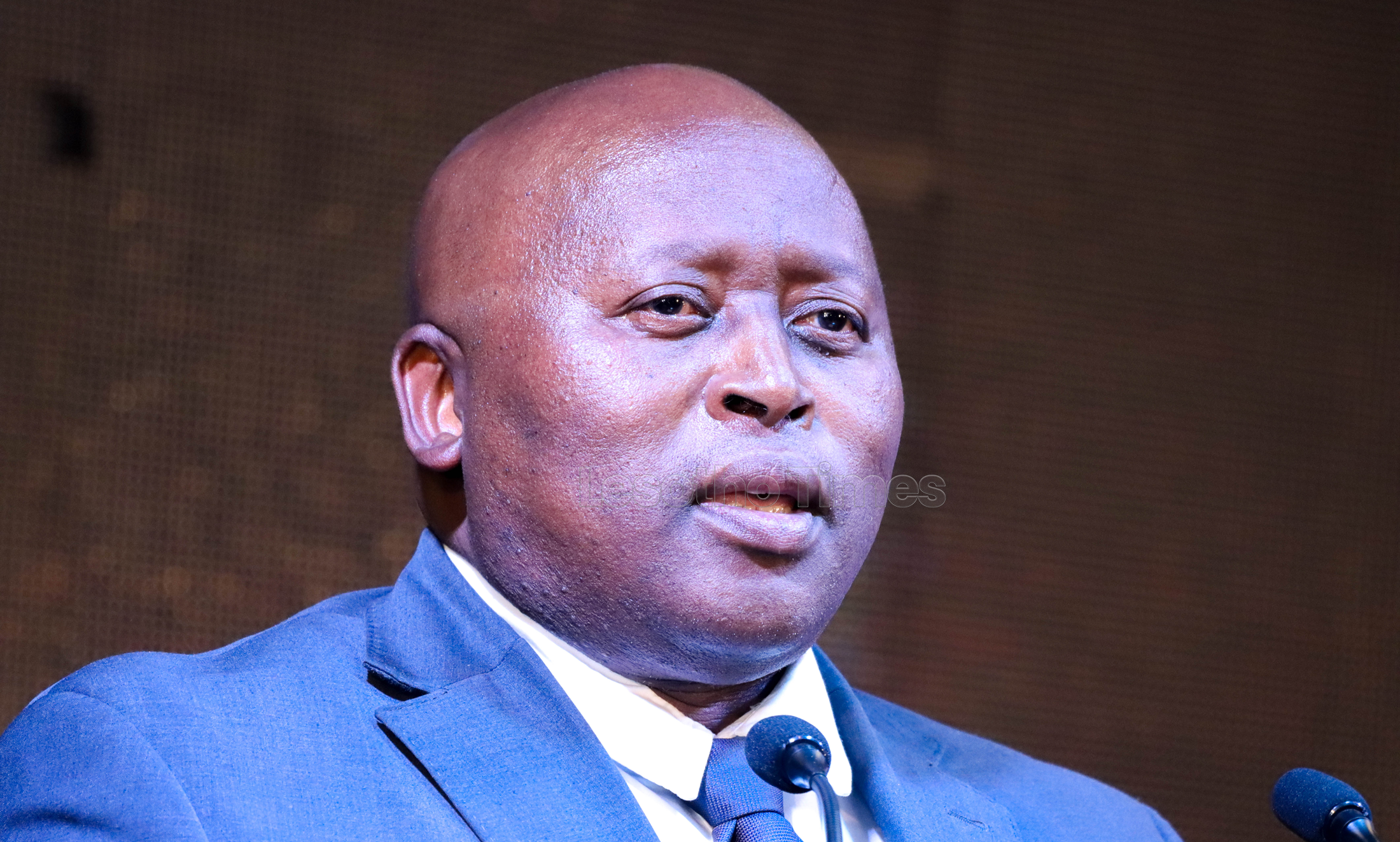
. . . as Minister clarifies trade pact after US trip
. . . takes stock of impact if it is not renewed
THE Minister of Trade, Industry, and Business Development, Mokhethi Shelile, has stressed that the African Growth and Opportunity Act (AGOA) is not a charitable favour from the United States but a mutually beneficial trade framework.
His strong remarks come after a recent high-level lobbying mission to Washington D.C., where he engaged with members of the US Congress, the Ways and Means Committee, and the Finance Committee to push for AGOA’s renewal beyond its expiry earlier this week.
Mr Shelile had been accompanied to the meeting by Ministers of Labour and Employment, Tšeliso Mokhosi, and Finance and Development Planning, Retŝelisitsoe Matlanyane, officials from the Ministry of Foreign Affairs and International Relations, and representatives of the Lesotho Textile Exporters Association.
In an exclusive interview with the Lesotho Times senior journalists Mohloai Mpesi and Mathatisi Sebusi yesterday, Mr Shelile detailed his mission, the implications of AGOA’s potential lapse, and how Lesotho is preparing for alternative markets.
LT: You recently travelled to the United States to negotiate for the extension of AGOA. Please take us through your journey.
Shelile: The mission was not to negotiate but to lobby. I was also part of the team that successfully lobbied for the 2015 extension of AGOA to 2025.
This time, we directly engaged with US lawmakers because AGOA is legislation — it is Congress and the Senate, not the White House, that decide on it. We met with members of the Ways and Means Committee, the Finance Committee, and other congressional players who shape AGOA’s future.
We stressed that AGOA is a partnership, not a one-way street where Africa benefits while America gives. In fact, more than 350,000 jobs in the US are linked to AGOA — especially in logistics and warehousing. When you remove Nigerian petroleum from the equation, the US – Africa trade balance actually tilts in Africa’s favour, which proves how valuable the agreement is for both sides.
The good news is that we found bipartisan support — both Republicans and Democrats recognised AGOA’s importance. However, Republicans in particular emphasised that they are waiting for guidance from the White House.
We also held engagements with the United States Trade Representative (USTR) (Jamieson Greer), the Foreign Affairs Committee, and the National Security Council (NSC). Each of these agencies acknowledged AGOA’s importance.
Our last meeting with the NSC gave us an indication that a one-year extension is most likely, and this has since been reported by Bloomberg and the Washington Daily, citing sources in the Trump administration.
This one-year window is critical — it gives both sides breathing room to redesign AGOA into a trade pact that aligns with “America First” priorities while still protecting African economies.
LT: If AGOA is not extended beyond the year, how badly will Lesotho be affected?
Shelile: The impact would be immediate and severe. About 12,000 direct jobs are at risk, with 11 factories likely to be hit hardest. Indirectly, another 40,000 people in logistics, transport, housing, and retail could lose income because of reduced demand.
Some projections suggest that Lesotho’s GDP could contract by up to 6% if AGOA is lost permanently — though, of course, that figure still requires independent verification.
The loss of foreign currency inflows is also worrying. Projects like the Polihali Dam and essential imports such as electricity from Mozambique are all dollar denominated. At present, the Central Bank says we have around five and a half months of foreign reserves, which is healthy — but that buffer could shrink quickly without AGOA inflows.
Already, only 20% of Lesotho’s textile production is exported to the US, a sharp decline from earlier years when AGOA was stable.
LT: What is the government doing to mitigate potential losses?
Shelile: Absolutely. We are repositioning towards the Southern African Customs Union (SACU) market, which is large and has growth potential. SACU’s current industrial policy requires 80% of garments to be sourced locally, up from 30%. This opens opportunities for our factories, and we are working to attract foreign direct investment (FDI) focused on SACU demand.
Since June last year, our exports to the US have fallen below 50%. The uncertainty surrounding AGOA has made US buyers hesitant. They prefer short lead times — products delivered within three months. But Lesotho’s production and logistics cycle is much longer.
Raw materials are mostly imported from China, which takes six weeks to arrive. Add sampling, production, shipping to Durban, and transport to the US, that’s another six weeks and the cycle is already too long. Worse still, American buyers typically pay only after goods are sold in stores. That means factory owners wait nearly a year before receiving revenue, while still covering salaries, utilities, and operating costs.
This cash flow challenge discourages Basotho from entering the textile industry. Without upfront capital, it’s nearly impossible to survive the first year of production.
We are also exploring the African Continental Free Trade Area (AfCFTA). It has huge potential, but logistics are a barrier. For example, exporting to Zimbabwe outside SACU can take two weeks just to clear border posts. To unlock AfCFTA, we need harmonised customs systems and a unified approach to border management.
LT: Will the lapse in AGOA affect the 15% reciprocal tariffs? Could they increase?
Shelile: AGOA itself allows us to export duty-free. But under the Trump administration, reciprocal tariffs were introduced separately under a state of emergency.
If AGOA lapses, we revert to World Trade Organization (WTO) Most Favoured Nation (MFN) rates. That means:
- Cotton garments face 16.5% tariffs
- Man-made fibre garments face 32% tariffs
When you combine those with reciprocal tariffs, the effective costs rise to 31.5% for cotton garments and 47% for synthetics.
That would make Lesotho’s garments completely uncompetitive in the US market. This is why AGOA’s continuation — or a strong replacement agreement — is not just desirable, but essential for the survival of our textile industry.
