
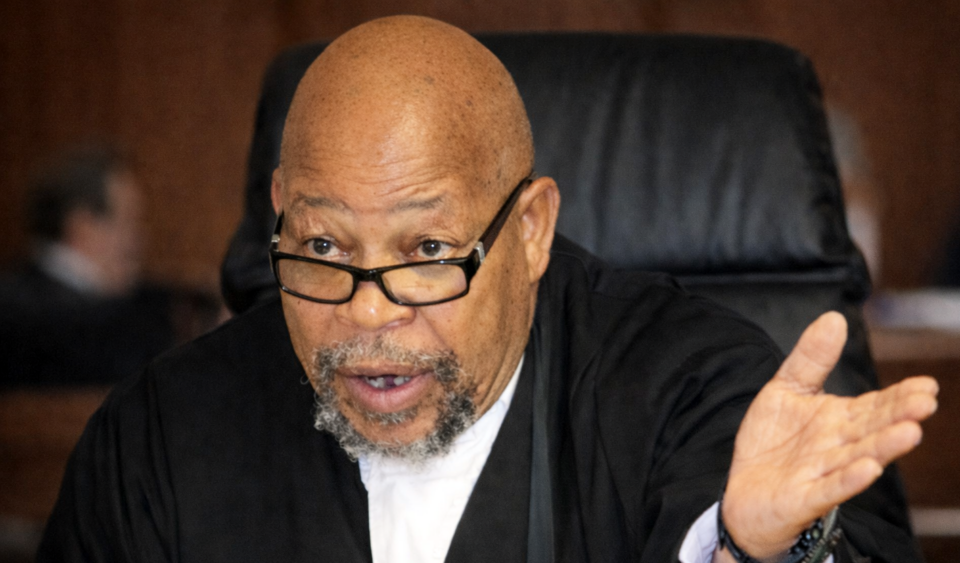
…orders him back to finish 128 judgments, rejects “forced labour” claim
Moorosi Tsiane
THE Constitutional Court has dismissed retired Justice Tšeliso Monapathi’s bid to access his pension benefits, ordering him instead to complete 128 long-outstanding judgments – some dating back decades – and condemning his conduct as a serious dereliction of constitutional duty.
In its ruling delivered this week, the three-member constitutional bench found that Justice Monapathi had failed to discharge his constitutional responsibilities and must finalise all pending cases, including 11 part-heard matters, despite having retired in August 2024 after reaching the mandatory retirement age of 75.
Justice Monapathi had approached the Constitutional Court in July last year, accusing Chief Justice Sakoane Sakoane of unlawfully withholding his pension and subjecting him to what he described as “forced labour” by requiring him to complete outstanding judgments before accessing his benefits.
The matter was heard on 15 January 2026 by Justices Mankhabimba Mkandwire (Malawi), Sylvester Mainga (Namibia) and David Mangota (Zimbabwe).
Justice Monapathi was represented by Advocate Mochate Makara, while the Chief Justice was represented by Adv Rudie Cronje.
Adv Makara argued that the Chief Justice had no legal authority to tie the release of retirement benefits to the completion of pending judgments.
“Section 151 of the Constitution is explicit that once a judge has retired, he must be paid his terminal benefits,” Adv Makara submitted.
He maintained that Justice Monapathi retired by operation of law upon attaining the age of 75 and was therefore entitled to his benefits as of right. While conceding that his client had outstanding judgments, Makara argued that this could not justify withholding constitutionally guaranteed benefits.
He further told the court that Justice Monapathi had requested office space, a judge’s clerk and a laptop to complete the work, but these were not provided.
Adv Makara also attributed the backlog to systemic challenges within the judiciary, including heavy workloads and limited resources.
“It is not Justice Monapathi’s fault that his work is unfinished. Judges are overworked; courts are under-resourced and understaffed. The Chief Justice has no powers whatsoever to withhold his benefits,” he argued.
He added that any alleged dereliction of duty should have been addressed through disciplinary processes while Justice Monapathi was still in office.
“A judge is paid to protect the institutional independence of the courts. Terminal benefits cannot be interfered with by the Chief Justice or anyone else. Justice Monapathi has not been removed from office for misconduct; he is retired,” he said.
Adv Makara further submitted that his client was willing to complete the outstanding work—but only if he was paid.
“One cannot be expected to work without pay. That is unconstitutional,” he argued, invoking Section 9 of the Constitution.
However, the state mounted a robust opposition. Adv Cronje argued that judicial independence must go hand in hand with accountability, stressing that judges are bound by strict timelines.
“The Code of Ethics for judges requires that judgments be delivered within three months.
“The applicant still has pending judgments dating as far back as 1995.”
He accused Justice Monapathi of attempting to evade responsibility, arguing that the public has a right to timely justice.
“A sitting judge must account for his work. Judgments must be delivered within stipulated timeframes. The public expects the courts to deliver justice,” Adv Cronje said.
He warned that granting the application would set a dangerous precedent.
“It can never be that a judge has the discretion to work beyond the age of 75 at his own choosing. That would be the darkest day of the judiciary,” he argued.
In its ruling, the Constitutional Court sided largely with the Chief Justice, delivering a damning assessment of Justice Monapathi’s conduct.
“To delay judgments for decades… is a serious dereliction of constitutional duty. We may add, an obstruction of justice,” the court held.
It dismissed Justice Monapathi’s claims as baseless.
“With the greatest respect to the applicant, his narrative rings hollow and is meritless. There is no evidence that the first respondent interfered with judicial independence or imposed forced labour,” the court said.
The judges emphasised that completing pending cases was a constitutional obligation, not a matter of choice.
“Applicant himself accepts that the pending cases are his constitutional obligation to finalise,” the judgment reads.
The court further upheld Justice Sakoane’s decision to withhold the pension, describing it as lawful and justified.
“The decision to process the applicant’s retirement benefits subject to the completion of all outstanding judicial work is an administrative directive tailored for a legitimate purpose,” the court ruled.
It stressed that judges cannot walk away from unfinished work upon retirement.
“A judge may not accumulate pending cases and choose not to continue. That could never have been the intention of the Legislature,” the court said.
In a particularly damning passage, the bench said Justice Monapathi’s conduct would likely have attracted disciplinary action in other jurisdictions.
“In many jurisdictions, the applicant would long have been subjected to disciplinary measures… Prima facie, he has failed to discharge his constitutional duties. His understanding of judicial independence is totally misplaced,” the judgment reads.
However, the court partially upheld his application, ruling that he should receive the benefits of a judge while completing the outstanding judgments.
“To sum up, the applicant has no discretion whether to continue or not… he cannot access his pension before finalising all pending cases.
“In the event that the applicant complies, he shall be paid the benefits of a Puisne Judge for the period during which he finalises the outstanding cases. The remainder of the application is dismissed,” the court said.
