
…as RSL collects M9.76 billion
Moroke Sekoboto
THE Revenue Services Lesotho (RSL) has missed its M10.39 billion revenue target, remitting M9.76 billion and recording a negative variance of M640.3 million.
Despite the shortfall, RSL collections increased by 3 percent from last year’s M9.74 billion.
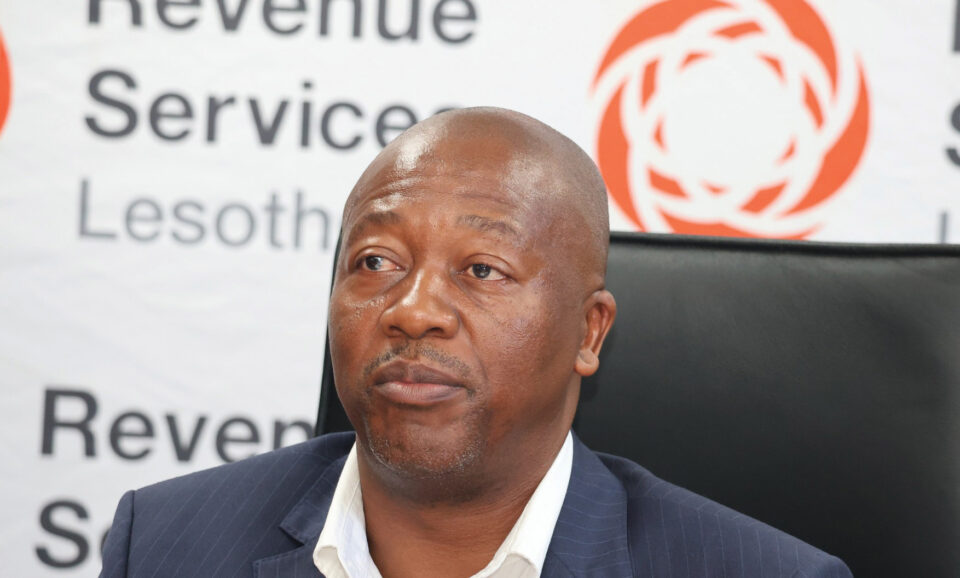
RSL Acting Commissioner General, Rakokoana Makoa, said while total tax collections exceeded the target, the final remittances were reduced by significant refunds.
“For the financial year 2025/2026, the government set RSL a combined annual revenue target of M10.39 billion. Against this target, RSL remitted M9.76 billion, resulting in a negative variance of M640.3 million.
“The overall tax collection amounted to M10.89 billion, but this was affected by refunds of M1.13 billion. This performance represents an increase of 3 percent compared to the previous year, demonstrating a proportional improvement in overall tax collection,” Mr Makoa said.
He said, as in the previous financial year, 2025/26 presented significant challenges for RSL, the business community and taxpayers.
“Last year, for the financial year ending March 31, 2025, RSL remitted M9.74 billion to the government, exceeding the previous year’s performance by 9.9 percent and recording a positive variance of M261.2 million. While the economic environment remained complex, this performance reflected the resilience of Lesotho’s tax administration and the commitment of taxpayers,” he said.
Mr Makoa said Income Tax remained the largest contributor to government revenue.
“We targeted M5.16 billion for Income Tax and remitted M5.44 billion, exceeding the target by M28 million (5.4 percent). This category includes Personal Income Tax, Corporate Income Tax, Withholding Tax and Fringe Benefits Tax,” he said.
He said the Value Added Tax (VAT), a major revenue source linked to consumption patterns, underperformed.
“We set a target of M5.05 billion but collected M4.11 billion, missing the target by M940 million (18.6 percent). For Tobacco and Alcohol Products Levy, the target was M174.17 million, while actual remittances reached M195.36 million, exceeding the target by M21.19 million (12.2 percent),” Mr Makoa said.
He added that although the Gaming Levy contributed a relatively small share, the sector recorded notable growth. The M9.60 million target was exceeded by M2.4 million (24 percent), with remittances reaching M12 million.
“During the year, RSL processed tax refunds amounting to M1.13 billion. Refunds remain crucial in maintaining a fair and credible tax system, ensuring that businesses and individuals receive what is rightfully due to them,” he said.
The overall tax contribution breakdown was: Income Tax (55.8 percent), VAT (42.1 percent), and Tobacco and Alcohol Levy together with Gaming Levy (2.1 percent).
Turning to the broader economic context, Mr Makoa said the year unfolded against an increasingly challenging global environment.
He said while the economy was supported by construction activities under Phase II of the Lesotho Highlands Water Project, it remained vulnerable to external shocks, including global unrest, trade tensions and climate change.
“Global growth has remained modest, with the IMF projecting 1.4 percent growth for both 2025 and 2026, far below the pre-pandemic average of 3.7 percent. Sub-Saharan Africa is projected to grow at 4.6 percent.
“South Africa, Lesotho’s largest trading partner, is expected to grow by 1.4 percent in 2026. Lesotho’s economy has grown more slowly than anticipated at around 1.4 percent and is projected to decline further to 1.1 percent in 2027,” he said.
He added that inflation eased to 4 percent in 2025 and is projected to rise to 4.6 percent in 2026, slightly easing pressure on consumers compared to the previous year.
“This has shifted consumer demand towards lower-priced and often lower-taxed goods. Taxable imports grew by 3.9 percent (M71.8 million), improving from 3 percent last year, while non-taxable imports declined by 42 percent (M233.4 million),” Mr Makoa said.
He said these trends directly affected VAT performance.
“The improvements are a result of implementing robust revenue collection strategies, including intensified customs inspections and anti-smuggling initiatives, while also facilitating smoother cross-border trade,” he said.
Mr Makoa also said the national tax-to-GDP ratio improved from 22.5 percent to 22.9 percent, with a tax buoyancy ratio of 1.7 percent, while annual remittances grew marginally by 0.1 percent.
