
…warns corrupt judicial officers
Moorosi Tsiane
CHIEF Justice Sakoane Sakoane has drawn a line in the sand, warning corrupt judicial officers that their days on the bench are ominously numbered.
The Chief Justice stressed that any judicial officer who betrayed their oath of office would find no refuge under his leadership. He has also vowed to crack the whip against judges and magistrates who delay issuing judgments while also urging society to desist from trying to influence judicial outcomes.
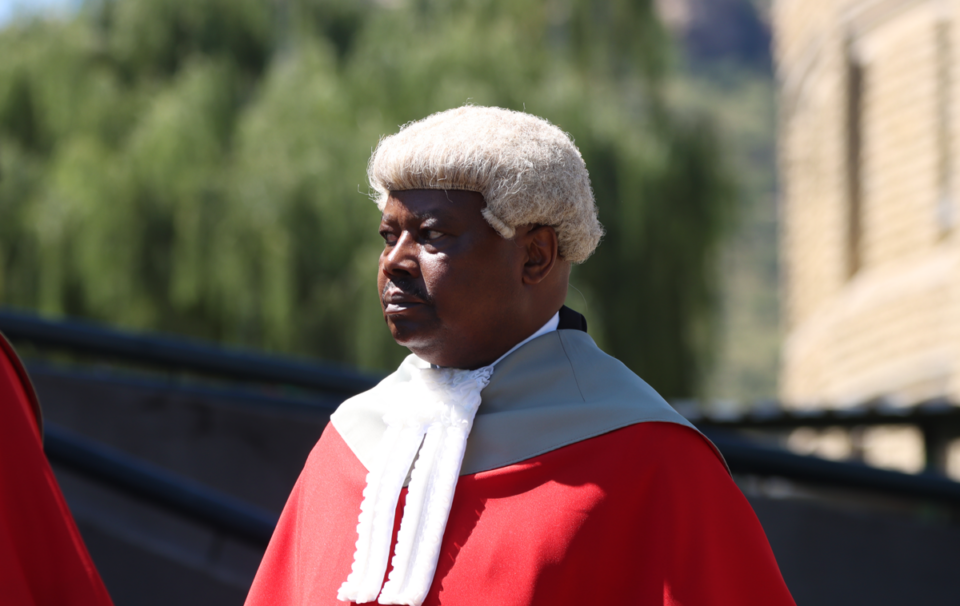
Chief Justice Sakoane delivered his no-nonsense address to judicial officers while opening the High Court’s 2026 legal year on Monday.
He said integrity in the judiciary was non-negotiable as corruption represented a direct betrayal of justice itself.
The annual opening, traditionally held on the first Monday of every February, was marked by a ceremonial procession of judges and court officials led by the Lesotho Defence Force. Senior government officials and international development partners attended the event.
In his keynote address, Justice Sakoane expressed deep concern over corruption, unethical conduct and delays in delivering judgments, which he said continue to erode public confidence in the courts.
“Corruption is not only a crime; it is a betrayal of the judicial oath and the very salvation of justice. As the head of the judiciary, I will not shield wrongdoing,” Justice Sakoane said.
He warned that delayed rulings weakened confidence in the justice system and put the judiciary into disrepute.
“Disciplinary measures are therefore appropriate and necessary to ensure and enforce judicial accountability. Another issue that leads to the loss of public confidence in our courts is corruption and unethical conduct. Allegations of corruption corrode trust and diminish the moral authority of the judiciary.”
In a blunt call to the legal profession, the Chief Justice urged magistrates and lawyers of “unquestionable integrity” to avail themselves for judicial appointment, saying the bench must be occupied by individuals whose characters inspire public trust.
“Do not deny justice or show partiality. Do not accept a bribe, for a bribe blinds the eyes of the wise and perverts the cause of the righteous. Pursue justice and only justice.”
Justice Sakoane also encouraged lawyers to submit their names through the Law Society for consideration for acting judicial appointments, describing such appointments as a critical recruitment tool that allows candidates to “learn the ropes” before committing to permanent service.
However, he warned that the judiciary would continue to struggle to attract experienced and suitable candidates unless government urgently improves judges’ conditions of service.
“Senior and experienced lawyers in private practice shy away from the bench because they earn more money outside,” he said, adding that competitive remuneration was essential to attract seasoned lawyers and ethical magistrates.
The Chief Justice was equally firm on judicial independence, declaring interference in judicial decision-making unacceptable.
Judges and magistrates, he said, must be free to decide cases without pressure from politicians, economic interests or public opinion, and must never be beholden to private or public interests.
But he also cautioned that independence goes hand in hand with accountability.
“Judges and magistrates are judged through their judgments — judgments that must be clear, reasoned, timely and according to law,” he said, warning that disciplinary action would be taken where accountability fails.
“Mechanisms for accountability and discipline exist in the Constitution and codes of ethics must be applied without fear or favour. Integrity is not optional; it is the cornerstone of a fair, clean and transparent judiciary.”
Justice Sakoane described corruption and unethical conduct as among the biggest drivers of public mistrust in the courts, cautioning that even unproven allegations can weaken confidence and erode moral authority.
At the same time, he warned against reckless attacks, gossip and attempts to influence judicial outcomes.
“Unsubstantiated and unwarranted attacks on judicial officers undermine confidence in the judiciary,” he said.
The Chief Justice acknowledged long-standing challenges facing the justice system, including congested court rolls, procedural inefficiencies and delays that deny litigants timely resolution of cases.
“These failures have real human consequences,” he said. “Victims of crime wait years for closure, while accused persons remain in prison for extended periods awaiting trial.”
He said the judiciary has embarked on targeted reforms, including the introduction of new court rules aimed at streamlining procedures, curbing unnecessary interlocutory applications and promoting efficiency.
The reforms, he added, are intended to change legal culture and enforce discipline through active judicial case management.
