
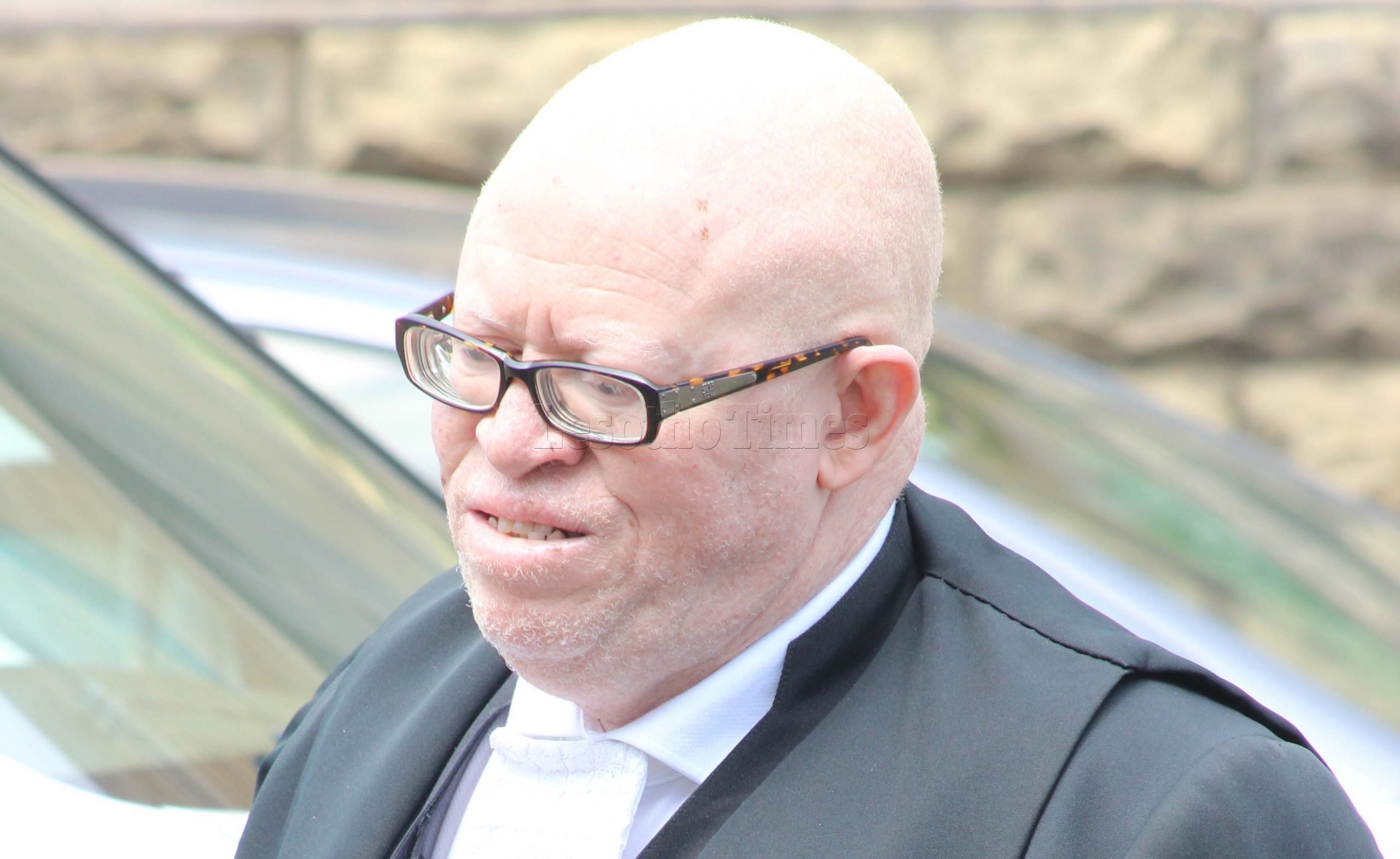
…as he assumes university’s leadership after court victory
By Moorosi Tsiane
PROFESSOR Kananelo Mosito this week took charge of the National University of Lesotho (NUL) after the Court of Appeal nullified the university Council’s appointment of Professor Motlatsi Molati as Acting Vice-Chancellor and reversed Prof Mosito’s dismissal as Pro-Vice-Chancellor.
Prof Mosito, whose contract as Pro-Vice-Chancellor was terminated on 2 August, returned to NUL on Tuesday, a day after the apex court found that the Council had defied an earlier court order protecting his right to act as Vice-Chancellor.
The court ruled that the Council’s decisions to install Prof Molati and to fire Prof Mosito had no legal force for as long as the earlier order remained in operation.
The judgment effectively cleared the way for Prof Mosito, the substantive Pro-Vice-Chancellor when the vacancy arose, to assume the university’s highest executive office in an acting capacity.
Prof Mosito is also President of the Court of Appeal, a dual role the NUL Council has repeatedly argued undermines public confidence in the handling of the university’s cases before that court.
Speaking to the Lesotho Times yesterday, Prof Mosito confirmed that he had resumed work on Tuesday following Monday’s judgment.
“I have returned to the office from Tuesday this week as the judgment was delivered on Monday,” he said.
Asked whether he had received a warm welcome, Prof Mosito played down the issue, saying his immediate priority was the university’s work.
“We are here to work and that is what is important for now. However, there is really nothing much to talk about for now,” he said.
His return is the latest twist in a protracted legal battle over the leadership of NUL. The dispute erupted after the Council began recruiting a successor to the then Vice-Chancellor, Professor Olusola Isaac Fajana, in October 2025, following his notice that he would not renew his contract.
Prof Mosito challenged the recruitment in the High Court in May 2026, arguing that sections 16(2) and 17(4) of the National University of Lesotho Order, 1992, did not permit the process to begin before the office actually fell vacant, and that the Pro-Vice-Chancellor was required by law to act as Vice-Chancellor the moment a vacancy arose.
The Council suspended him on 22 April 2026, accusing him of rendering the university ungovernable in pursuit of personal interests. Prof Molati, who was then appointed Acting Pro-Vice-Chancellor, was later elevated to Acting Vice-Chancellor.
On 1 June 2026, Acting Justice of Appeal Phillip Musonda halted the recruitment process and sought to preserve the statutory succession mechanism in section 17(4) of the NUL Order.
Justice Musonda ordered that, upon a vacancy arising, section 17(4) would “take effect according to its terms”, with the Pro-Vice-Chancellor, “by operation of law and without the necessity for any further decision”, immediately assuming the powers, functions and duties of Vice-Chancellor in an acting capacity until a substantive Vice-Chancellor was lawfully appointed.
The order also barred any person or organ of the university from taking action inconsistent with, or intended to circumvent, frustrate, defeat or undermine, the operation of section 17(4) or the Pro-Vice-Chancellor’s assumption of office.
Prof Fajana’s contract expired on 31 July 2026. That day, Prof Mosito presented himself at the Roma campus to assume the acting functions but was blocked from entering.
The Council then appointed Prof Molati as Acting Vice-Chancellor and, on 2 August, terminated Prof Mosito’s four-year contract as Pro-Vice-Chancellor two years before its expiry, although he retained his substantive post as a lecturer in the Faculty of Law.
Prof Mosito responded by petitioning the Court of Appeal to find university officials in contempt of Justice Musonda’s order and to nullify both Prof Molati’s appointment and his own dismissal.
The application was heard on 31 August by a panel of Justices Petrus Damaseb, Johann van der Westhuizen and Moneuoa Kopo.
Delivering the unanimous judgment on Monday, Justice Damaseb found that the university had failed to comply with the earlier order by blocking Prof Mosito from assuming the acting functions.
“The existence of paragraph (e) of the 1 June 2026 order, the respondents’ knowledge of it and the material acts which followed are common cause. The applicant was prevented from entering the campus of the NUL to assume the acting functions as VC,” Justice Damaseb said.
“The second respondent (Molati) assumed and continues to exercise the acting office,” he added.
He said the earlier order was “extant and binding” when the university acted.
“Paragraph (e) of the order of 1 June 2026 was extant and binding. It operated upon the applicant as the substantive PVC and prohibited any person or organ of the NUL from taking or facilitating action inconsistent with, or calculated to circumvent, frustrate, defeat or undermine, the statutory succession which Musonda AJA sought to protect,” he said.
The university had relied, among other things, on Prof Mosito’s suspension to argue that he could not assume the acting position.
Justice Damaseb rejected that argument, finding that the suspension did not authorise the university to appoint someone else and fire Prof Mosito in circumstances covered by the court order.
“The pre-existing suspension created a genuine practical difficulty but did not authorise the later appointment and termination.
“More fundamentally, it was an anterior employment measure. While it remained extant for employment-law purposes, it could not be relied upon to prevent the statutory consequence expressly protected by the later judicial order,” he said.
He stressed that the court was not ruling on the validity of the suspension, which remains before the Labour Court.
“That conclusion does not determine the suspension’s validity, which remains for the Labour Court; it determines only whether the suspension could justify conduct prohibited by an extant order of this Court,” he said.
He added that if the university believed the suspension and the court order were in conflict, it should have urgently approached the court for clarification before acting.
The judge noted that the university had not argued that Prof Mosito’s attempt to take office on 31 July was premature. Its case was instead that the suspension barred him from acting.
“The inescapable inference is that, even if the vacancy arose that day, they did not intend to permit him to assume the acting functions. That is sufficient to establish objective non-compliance,” Justice Damaseb said.
The court, however, stopped short of holding the university or any individual official in contempt.
“It does not compel the further penal conclusion that the respondents acted wilfully and mala fide,” Justice Damaseb said.
He said Prof Mosito’s immediate grievance could be remedied through declaratory and restorative relief without determining whether the non-compliance was wilful or in bad faith.
“The admitted non-compliance must be accompanied by an effective remedy. The Court therefore makes no present finding of contempt against the institution or any individual respondent,” he said.
But he stressed that this restraint did not amount to endorsing the university’s conduct.
“That restraint does not validate the conduct. The established breach justifies a declaration, reversal of its continuing consequences and a peremptory direction to comply,” he said.
The court declared that the NUL Council had failed to comply with paragraph (e) of the 1 June order by preventing Prof Mosito from exercising the functions of Acting Vice-Chancellor after the vacancy arose on 31 July.
It further declared that Prof Molati’s appointment as Acting Vice-Chancellor and the termination of Prof Mosito’s appointment as Pro-Vice-Chancellor had no force or effect for as long as paragraph (e) remained operative.
The court also dismissed the university’s objection that it lacked jurisdiction to hear the application as a court of first instance.
The university’s counter-application to review and set aside paragraphs (d) and (e) of Justice Musonda’s order was struck from the roll because the prescribed procedure had not been followed.
Prof Mosito said he would leave the implications of the judgment for other pending cases, including the question of costs, to the lawyers.
“I wouldn’t know what they are thinking of those cases because they are obviously not going to discuss that with me. But I think all that rests with the lawyers… especially the issue of costs,” he said.
On the Labour Court challenge to his suspension, Prof Mosito said: “The matter has now been overtaken by events because I am no longer suspended.”
That position may yet be contested. The Court of Appeal expressly said the suspension remained extant for employment-law purposes and declined to rule on its validity, leaving that question to the Labour Court.
Monday’s judgment also does not end the wider dispute over the appointment of a substantive Vice-Chancellor. Prof Mosito’s challenge to the recruitment process remains pending before the High Court, while the Council’s appeal against the High Court’s jurisdiction to hear that case is still to be decided by the Court of Appeal.
