
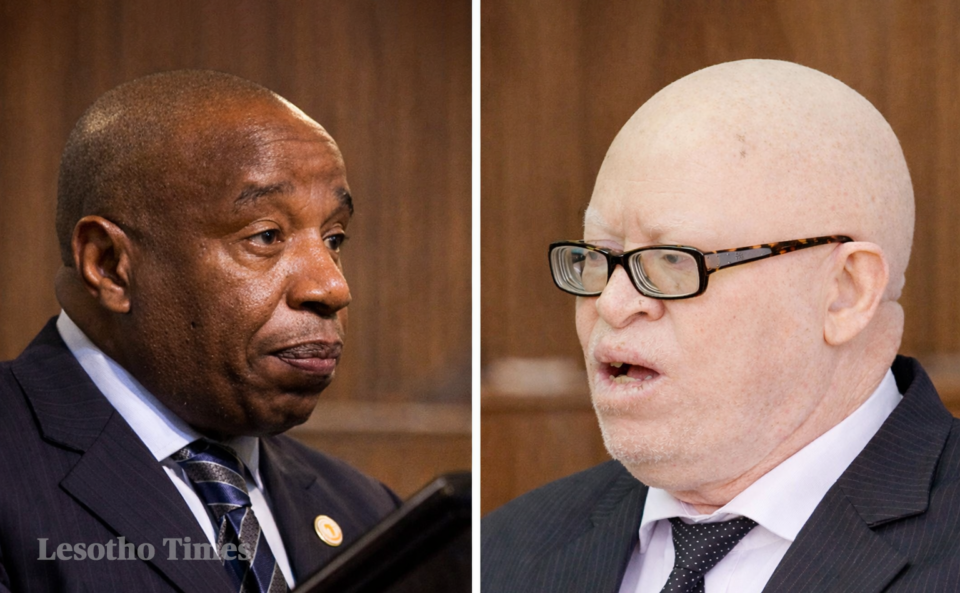
…as top officials trade serious accusations
…Matlosa brands Mosito a “bully”
…pushes for foreign judges as Vice-Chancellor battle intensifies
Moorosi Tsiane
TENSIONS at the National University of Lesotho (NUL) over the recruitment of a new Vice-Chancellor have escalated into a bitter confrontation between some of the institution’s most senior officials.
In a legal battle now before the High Court, NUL Council Chairperson, Dr Khabele Matlosa, accuses NUL Pro-Vice-Chancellor, Professor Kananelo Mosito, of bullying, intimidation and dividing the university into rival camps.
This after Prof Mosito, who is also the Court of Appeal President, filed an urgent High Court application seeking to block the recruitment process. He argues that the incumbent Vice-Chancellor, Professor Olusola Isaac Fajana, only completes his term in July 2026 and any new recruitment process should only start when the latter’s office becomes vacant.
Prof Mosito maintains that the recruitment process is unlawful because it was initiated before a vacancy arose, allegedly in breach of Section 16(2) and (6) of the National University of Lesotho Order, 1992. He contends that recruitment can only begin once a vacancy exists, which would be in August 2026.
However, his application has drawn sharp criticism from the NUL Council, which has accused him of “abuse of power”.
Dr Matlosa has since upped the ante by filing an interlocutory application seeking the recusal of all High Court judges from the matter because they would likely be “biased” in favour of their boss Prof Mosito. He instead wants foreign judges appointed.
Dr Matlosa argues that Prof Mosito’s role as President of the Court of Appeal places him in a position of influence over High Court judges, some of whom also sit in his appellate court on an ad hoc basis.
Dr Matlosa alleges that Prof Mosito’s behaviour has not only intimidated colleagues but has also fractured the institution’s internal cohesion.
“This is an interlocutory application for recusal of all the judges of the High Court on the grounds of perceived impartiality occasioned by the fact that the applicant (Mosito) in the main matter also serves as President of the Lesotho Court of Appeal, hence a colleague and a functional superior of all judges of the High Court,” Dr Matlosa states.
He insists that the university’s concerns are justified and grounded in observed conduct.
“The University’s apprehension is neither disdainful, chicken-hearted, nor unreasonable. It is also founded on the observed personal conduct of the fourth respondent (Mosito), deduced from his interactions with members of the university’s management and the Council that employs him.”
Dr Matlosa goes further to outline what he describes as a pattern of troubling behaviour by Prof Mosito, alleging that it has had a direct impact on the university environment.
“Bullying and intimidation of colleagues, abject disregard for authority, usurpation of other employees’ functions, such as the University’s in-house lawyers, and consciously or unconsciously causing the existence of two camps within the University: Prof Mosito’s loyalists and others who are not his loyalists,” he states in a blistering critique of the top judge’s behavior.
He adds that these alleged traits raise serious concerns about the integrity of the judicial process, should High Court judges preside over the matter.
“It is based on knowledge of the above personality and character traits that I can almost predict that Prof Mosito will take steps, and perform acts intended to influence and/or intimidate, or otherwise try to exert pressure on any judge of the High Court to influence the decision in the main matter,” he says.
Dr Matlosa argues that the unique position held by Prof Mosito — as head of the Court of Appeal — creates an unavoidable conflict.
“I submit, therefore, that for the aforementioned grounds, the University has a reasonable apprehension that no judge of the High Court will be impartial if required to adjudicate on a matter involving the interests and/or rights of their work colleague and functional superior. Naturally, none of them would want to be in the President’s bad books… The presumption of impartiality that works in favour of the judges in cases of this nature is affected by the level of influence attaching to Fourth Respondent arising out of his being President of the Court of Appeal.”
In light of this, the council proposes that judges from outside Lesotho be brought in to handle the matter, citing neighbouring jurisdictions such as South Africa, Zimbabwe, Namibia and Malawi as possible sources of alternative adjudicators.
Supporting Dr Matlosa’s claims, Prof Fajana also filed an affidavit echoing concerns about Prof Mosito’s conduct and its impact within the university.
“I confirm that Prof Mosito tends to act and/or utter words that have the effect of intimidating, bullying, and threatening his colleagues and members of the university executive management, conduct which is exacerbated by common knowledge that he is the President of the highest court in Lesotho,” said Prof Fajana.
He further describes a deeply divided institution.
“I aver further that owing to the untenable circumstance of working with the President of the Court of Appeal, who inevitably carries the status and influence that attaches to the position, there are two camps in the University, those who prefer to answer, report, and owe allegiance to the Fourth Respondent, and those who don’t. This state of affairs is observable in the management cadre as well as the lower ranks.”
NUL also questioned the jurisdiction of the High Court to deal with the matter.
When the case commenced this week, counsel for NUL, Advocate (Adv) Mamello Makau, informed the court that the council had filed the interlocutory application seeking the recusal of all High Court judges and requested that it be dealt with before any arguments on jurisdiction.
“My Lord, this morning we have filed an interlocutory application seeking the recusal of all High Court judges, the application is not only directed to his Lordship but the entire bench and we would have liked the court to make a determination on this matter before we can argue jurisdiction,” she submitted.
However, Adv Dominic Metlae, representing Prof Mosito, strongly opposed that approach, insisting that the court must first determine whether it has the authority to hear the case.
“My Lord, if the court does not have jurisdiction then the recusal is academic. So the court has to determine first whether it has jurisdiction to hear the matter, then the issues of recusal will follow after,” he argued.
After a brief adjournment, presiding Judge Molefi Makara ruled in favour of Adv Metlae’s position, directing that arguments on jurisdiction be heard first.
In her submissions, Adv Makau argued that the dispute is fundamentally a labour matter arising from Prof Mosito’s employment relationship with the university council.
“…His locus standi in the matter results from the employment contract, as Section 17(1) of the NUL Act 1992 entitles him to. This case arises from an employment contract as a Pro-Vice-Chancellor. He is the direct employee of the Council, answerable to it through the Vice-Chancellor.
“Our view is that the Labour Act is applicable to him under this matter. His rights accrue from an employment contract. He is therefore before the wrong court, as this matter should be deliberated within labour jurisprudence,” she submitted.
Adv Makau also indicated that Prof Mosito has been suspended by the council, arguing that this development renders the case moot.
But Adv Metlae rejected this characterisation, maintaining that the matter goes beyond a simple employment dispute and falls squarely within the jurisdiction of the High Court.
“My Lord, NUL is not a private institution and the fact that the Head of State (His Majesty) is its Chancellor makes it a public institution. When Council resolved to appoint the joint committee to facilitate the appointment of the new Vice-Chancellor, it was not acting pursuant to a contract between NUL and Prof Mosito. This is not a contractual matter, but one with public impact. The Council decision was administrative and, as such, can be reviewed by the court,” he argued.
On the issue of mootness, Adv Metlae said Adv Makau was barred to making such a submission because she had not filed any documents to support her argument.
Following submissions from both sides, Justice Makara ruled yesterday that the High Court has jurisdiction over the matter. He will therefore proceed to hear arguments on the recusal application.
NUL Council suspended Prof Mosito last Friday, accusing him of “rendering the university ungovernable”.
However, Prof Mosito criticised the Council’s decision, saying his alleged transgressions had not been properly articulated, as the council had failed to specify how he committed them, thereby hindering his ability to respond to his suspension.
