
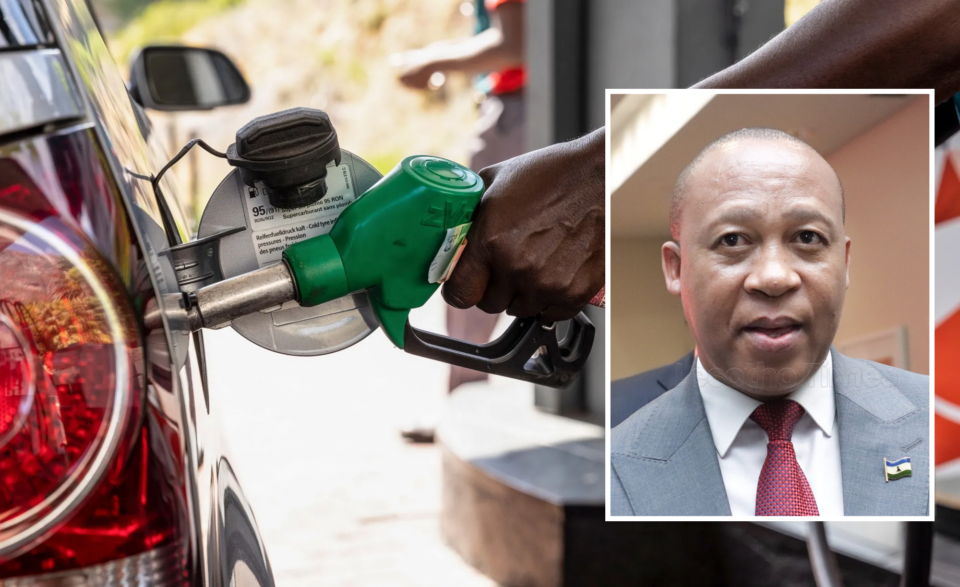
…says it is insufficient and misguided
Seithati Motsoeneng
THE leader of the Democratic Congress and Official Leader of the Opposition, Mathibeli Mokhothu, has criticised the government’s recently announced fuel subsidy, describing it as a superficial measure that fails to adequately support citizens grappling with rising living costs.
Mr Mokhothu said that despite the government’s claims of providing relief, the subsidy did little to ease the financial burden caused by fuel price increases.
Addressing the media in Maseru yesterday, he expressed disappointment with the government’s approach, saying the intervention lacks meaningful impact.
“The subsidy announced by the government does not mean anything significant, as the heavy costs associated with fuel hikes will still be borne by the public, which is unacceptable,” Mr Mokhothu said.
This is after Prime Minister Sam Matekane on Tuesday evening announced that the government would subsidise fuel for all Basotho following a proposed price hike that came into effect yesterday.
Mr Matekane said the increase is driven by global factors, including the ongoing conflict in the Middle East, which disrupted fuel markets.
He said the government would provide a subsidy on petrol, diesel and paraffin to cushion consumers. Petrol 93 increased by M6.70 per litre, with a government subsidy of M2 bringing the pump price to M22.50. Petrol 95 rose by M7.35 per litre, also with a M2 subsidy, resulting in a price of M23.30 per litre.
Diesel 50 increased by M13.10 per litre, with a M2 subsidy applied, bringing the price to M30.50 per litre. Meanwhile, illuminating paraffin rose by M13.30 per litre, with the government providing a higher subsidy of M5 per litre, resulting in a new price of M21.30.
Mr Matekane said the subsidy measures would be reviewed over a three-month period, during which the government would assess the situation and consider additional interventions.
He added that authorities were also considering expanding the list of zero-rated food items, including bread, sunflower oil and vegetables, to mitigate the broader impact of rising fuel costs on the cost of living.
However, Mr Mokhothu argued that the intervention did not address the broader challenge of inflation and the rising cost of living, which continue to strain many Basotho households.
He said Basotho faced increasing transport costs, higher prices for goods and services, and mounting inflation that is eroding purchasing power.
Mr Mokhothu said the government could have adopted a more comprehensive approach by fully absorbing the fuel price increase through targeted financial support, thereby shielding citizens from the impact.
“In 2022, when faced with a similar situation, the government provided a 100 percent subsidy on fuel price increases to protect citizens from the adverse effects of global fuel price hikes,” he said.
“That was a meaningful intervention that spared Basotho unnecessary hardship.”
Mr Mokhothu was deputy prime minister from 2020 to 2022 when his DC had formed a coalition with the All Basotho Convention.
He also criticised the government spending priorities, alleging that funds had previously been diverted to non-essential expenses such as ministers’ international travel instead of being reserved for urgent national needs.
“They have misappropriated contingency funds on non-essential expenditures and are now unable to intervene effectively in crises that directly affect people’s livelihoods.
“This reflects a lack of genuine concern for ordinary Basotho.”
Mr Mokhothu further accused the government of mismanaging contingency funds, arguing that resources had been used irresponsibly in the past.
“The government previously diverted contingency funds to finance trips abroad for ministers, which yielded little benefit for the nation. Now, as citizens struggle with rising fuel prices, there are insufficient resources to provide meaningful support,” he said.
He called on the government to prioritise citizens’ needs and introduce more effective measures to ease the burden of rising fuel costs.
“The current subsidy is a poor response to a crisis that significantly affects people’s lives. It is a half-hearted measure that does not reflect the urgency of the situation,” he said.
Mr Mokhothu urged the government to adopt transparent, responsible and people-centred policies.
“Leadership is about putting people first. The government’s failure to do so at this critical moment reflects misplaced priorities and a lack of genuine concern for ordinary Basotho,” he said.
