
…launches Country Strategy Paper for 2025–2030
Moroke Sekoboto
THE African Development Bank (AfDB) has unveiled a M3.8 billion (US$209 million) investment under Lesotho’s Country Strategy Paper (CSP) for 2025–2030, signalling a major shift towards large-scale, multisectoral projects aimed at accelerating economic growth and reducing the cost of doing business.
The new strategy prioritises investments in water, energy, information and communication technology (ICT), and private sector development, with a strong focus on sustainable economic transformation.
Unlike previous approaches that centred on smaller, fragmented projects, the CSP adopts a model built on fewer, larger and integrated operations designed to deliver maximum impact.
The AfDB’s 2025–2027 roadmap will serve as the initial implementation phase, comprising nine key operations. These include six sovereign operations targeting public sector infrastructure and three non-sovereign operations aimed at stimulating private sector investment.
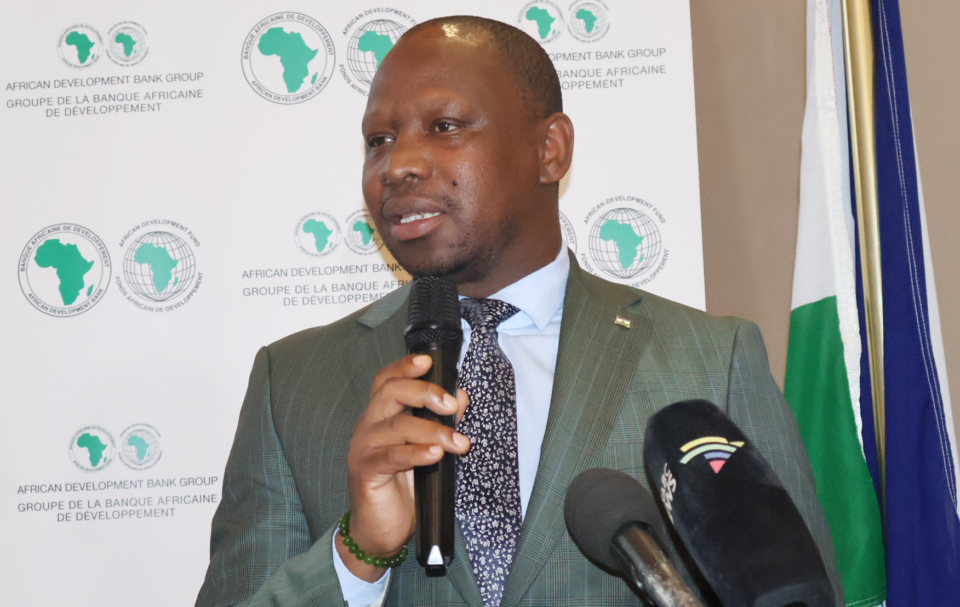
Launching the CSP in Maseru yesterday, Minister of Foreign Affairs and International Relations, Lejone Mpotjoane, hailed the AfDB as a long-standing and reliable development partner.
He said the Bank had played a pivotal role in financing major projects that might otherwise not have materialised.
“These projects are a testament to the Bank’s commitment to Lesotho’s growth and development,” Mr Mpotjoane said.
He said while Lesotho was endowed with valuable natural resources such as diamonds and water, these must be utilised strategically to ensure long-term productivity.
“Our high-quality diamonds and abundant water resources generate revenue through exports and royalties. However, these resources are finite and must be translated into sustainable economic value,” he said.
Mr Mpotjoane added that Lesotho also held significant renewable energy potential, which could position the country as a regional energy player if fully harnessed.
He said the CSP aligned with the National Strategic Development Plan (NSDP II) and directly addresses key constraints to economic growth.
“The strategy focuses on reducing the cost of doing business, lowering barriers to investment, and unlocking new opportunities for Basotho. Its emphasis on energy, ICT, water, and economic governance, combined with large-scale integrated projects, is both timely and necessary,” he said.
He further highlighted that cross-cutting issues such as climate resilience, gender equality, youth employment, and fragility were central to the strategy’s vision of inclusive growth.
Mr Mpotjoane acknowledged that the CSP came at a time when Lesotho faces multiple challenges, including economic pressures, climate risks, and global uncertainties.
“Despite these challenges, the government remains committed to reforms that will ensure the success of this strategy. We are maintaining fiscal discipline, supported by strong SACU revenues and water royalties, and creating fiscal space for strategic investments,” he said.
He added that efforts were ongoing to improve the regulatory environment, strengthen public financial management, and enhance project implementation capacity.
AfDB Southern Africa Region Office Deputy Director General and Country Manager for Lesotho, Moono Mupotola, said the Bank’s current portfolio in Lesotho comprises seven operations worth US$49 million (M824 million), covering water and sanitation, communications, governance, and energy.
She said water and sanitation accounted for the largest share at 37 percent, reflecting its critical importance to the country’s development.
Ms Mupotola highlighted the near-completion of the Lesotho Lowlands Rural Water Supply and Sanitation Project, which has reached 96 percent implementation and benefited 65,000 people in Berea and Maseru.
“The project includes 12 kilometres of pipeline, water distribution networks, and sanitation facilities designed to meet the needs of vulnerable groups, including women and persons with disabilities,” she said.
She added that the Lesotho Lowlands Water Development and Sanitation Project, approved in 2022, is expected to improve access to water and sanitation services for over 126,000 people in Butha-Buthe.
Ms Mupotola said the CSP is anchored on two main priorities: developing sustainable infrastructure to support industrialisation, and strengthening institutional and human capacity to improve public sector efficiency and private sector competitiveness.
AfDB Senior Country Economist for Lesotho, Cynthia Nyanchama, said the strategy builds on Lesotho’s unique development opportunities, including its youthful population, natural resources, textile industry, and renewable energy potential.
She said the CSP aims to address structural challenges while promoting inclusive growth through targeted investments.
“With a GDP of US$2.08 billion and a per capita income of US$1,160 in 2023, Lesotho remains a low-income country. However, it has significant untapped potential across multiple sectors,” Ms Nyanchama said.
She added that the strategy is expected to reduce production costs, unlock private sector growth, and expand economic opportunities for Basotho.
