
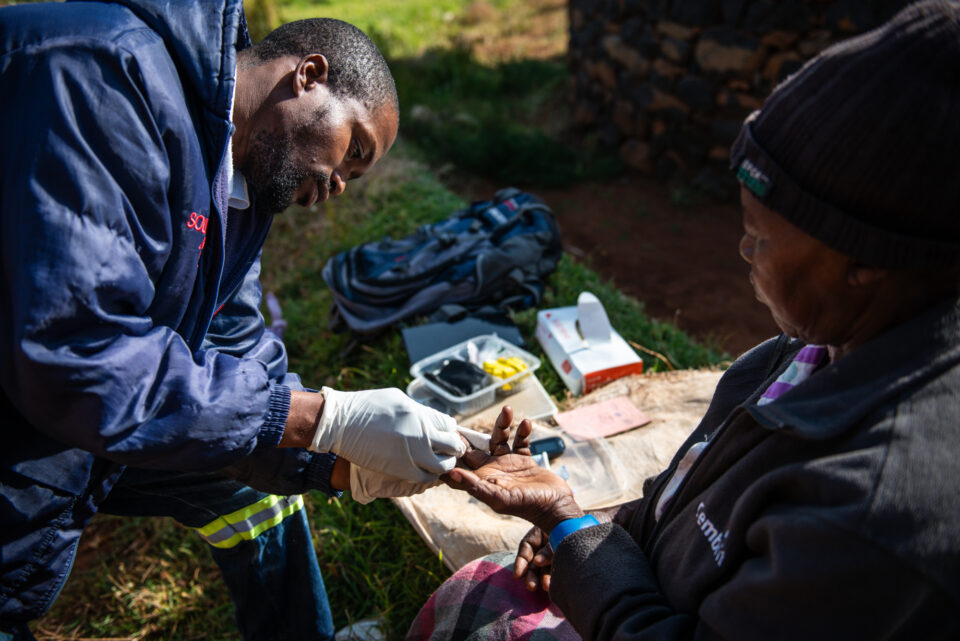
…community-based care in Butha-Buthe and Mokhotlong shows promising results
High blood pressure is one of the most serious but often unnoticed health problems in Lesotho. Many people live far from health facilities, especially in mountainous rural areas, and struggle to access regular care. As a result, hypertension often remains untreated until it causes stroke, heart failure, or kidney disease.
A new study conducted in rural Lesotho now shows that village health workers can safely and effectively help people control high blood pressure—right in their own homes.
A Lesotho-led project rooted in communities
The study was carried out as part of the Community-Based Chronic Care Lesotho (ComBaCaL) project in the districts of Butha-Buthe and Mokhotlong. ComBaCaL is implemented by a consortium consisting of the Ministry of Health Lesotho, the medical NGO SolidarMed, and the University of Basel, working closely with village leaders and community members.
Through ComBaCaL, village health workers are trained, supervised, and equipped with digital tools to screen, diagnose, and follow up people with chronic diseases such as hypertension and diabetes.
What did the study do?
Village health workers visited households in 103 rural villages, measuring blood pressure and identifying adults with uncontrolled hypertension. Participants were then followed for one year.
In some villages, people were referred to health facilities as usual.
In other villages, village health workers provided treatment directly, including:
- Measuring blood pressure at home
- Giving lifestyle advice
- Prescribing and adjusting first-line blood pressure medication
- Using a tablet-based decision support application to guide safe care
All services followed Lesotho’s national treatment guidelines.
Better results, closer to home
After 12 months:
- 58% of people treated by village health workers had controlled blood pressure
- Compared to 48% of those receiving standard facility-based care
There were no serious safety concerns, and people were more likely to stay in care when services were provided in their villages.
By the end of the study, more than 80% of participants in the community-care villages were still engaged in treatment.
Voices from the villages
For many Basotho, the biggest difference was access.
“When I test a patient in their home, I’m able to bring them the right medication, without them having to travel on the steep terrain to the health centre. This is especially helpful for elderly patients,”
says a village health worker from Mokhotlong.
Community members describe the impact on their daily lives:
“This project has really helped me. Before, I didn’t know what was wrong with me. Now I’m stronger and able to do my chores again,”
said one participant.
Others highlighted trust and communication:
“I was sceptical at first, but after some time we realised that this actually works,”
another participant explained.
Beyond hypertension: building integrated care
Importantly, the same community-based approach has also been successfully used for diabetes care in the same villages. Studies within the ComBaCaL project have shown that village health workers can safely monitor blood sugar levels, support treatment adherence, and improve long-term engagement in care for people living with diabetes.
Building on these successes, the next step is integration. Together with the Ministry of Health, the ComBaCaL project aims to integrate HIV prevention and HIV care services into the same community-based platform. The goal is to move away from fragmented, disease-by-disease programmes and instead develop and scientifically evaluate a comprehensive care package that brings essential services—hypertension, diabetes, HIV prevention, and HIV care—closer to people’s homes.
By testing this integrated model under real-life conditions, the project seeks to generate strong evidence to guide national policy and strengthen primary health care for communities across Lesotho.
Why this matters for Lesotho
Nearly two-thirds of Basotho live in rural areas. Long distances, transport costs, and staff shortages make chronic care difficult. This study shows that bringing care closer to people’s homes works.
Village health workers are trusted community members. With proper training, supervision, and digital support, they can reduce pressure on clinics while improving health outcomes.
Looking ahead
The results support expanding community-based care in Lesotho—not only for hypertension, but for other long-term conditions that require regular follow-up.
As one participant put it simply:
“I would recommend that people go to the village health worker. I don’t have any hesitation.”
