
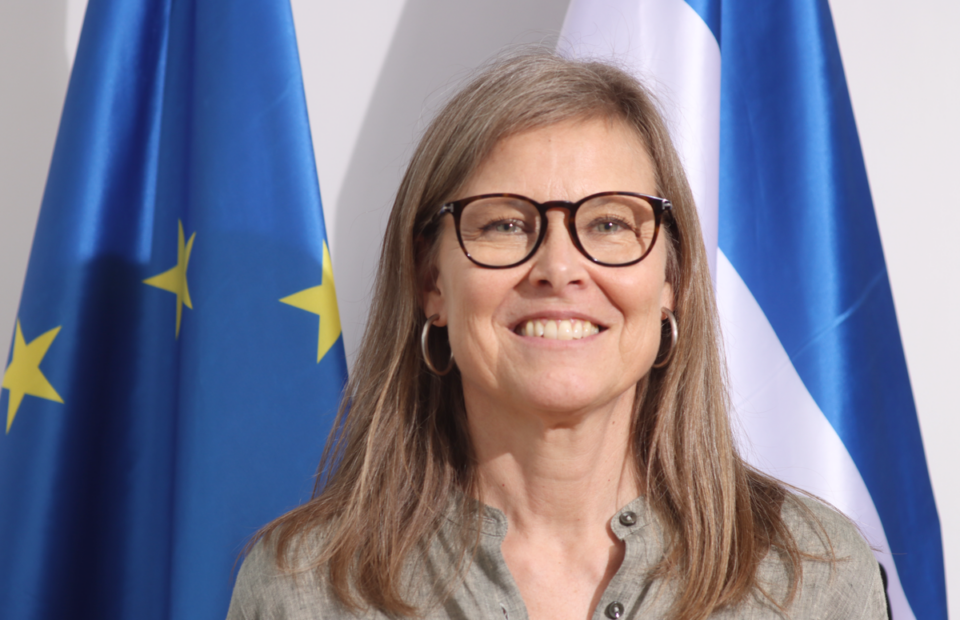
To accelerate the completion of Lesotho’s long protracted national reforms process, the new European Union (EU) Ambassador to Lesotho, Mette Sunnergren, advises putting clear timelines and benchmarks for goal implementation.
Ms Sunnergren, who assumed office late last year, replaced Paula Amadei, whose three-year term had ended. The reforms process, initiated by the Southern African Development Community (SADC) way back in 2016 to try and help achieve political and economic stability in Lesotho and has been partly funded by the EU, remains incomplete.
Civic society critics and other independent observers say it has for long been held hostage to the whims and caprices of politicians who – instead of using the reforms process to resolve long standing problems at the heart of perennial political instability in the Kingdom – have sought to exploit it to advance their own parochial partisan interests.
One of the latest hurdles to the reforms process is the Constitutional Court challenge of the August 2025 passage of the Tenth Amendment to the Constitution by civic society groups who argue the process was deeply flawed.
Ambassador Sunnergren believes enhanced stakeholder dialogue resulting in clear timelines and benchmarks to the reforms process would help achieve its completion.
She becomes the second woman to serve as EU Ambassador to Lesotho after Ms Amadei and brings with her vast diplomatic experience, having previously served in Mozambique, the Democratic Republic of Congo (DRC), Sudan and Zimbabwe. Her background positions her well to foster the continued strengthening of EU-Lesotho relations.
In an exclusive interview with the Lesotho Times (LT)’s Senior Reporter Mohloai Mpesi at her office in Maseru West this week, Ms Sunnergren stressed the need for the reforms to transcend party politics and be driven by strong political will to foster national progress and development.
Excerpts
LT: You have recently assumed your post as the European Union Ambassador to Lesotho. What are your first impressions of the country and its people so far?
Sunnergren: When I learned that I was coming to Lesotho, I only knew that it was mountainous, landlocked and a kingdom. I had to start reading up. I did not have big expectations about the people because I did not know what to expect. But when I arrived, my very first impression was the spring flowers.
For me, it was a beauty I had not expected. Coming from Europe, where it was beginning to be autumn, arriving in spring felt like a new beginning.
Now that I have travelled into the mountains, I am amazed every time. Behind every curve, there is something new to see.
When it comes to the people, I am struck by how positive many of those I meet are. They are always friendly and happy, and it is that positive attitude that stands out.
I have also noticed the traditional side, particularly the blankets. I did not think they were still worn, but people do wear them. I noticed they are worn during festive and ceremonial events, but when you travel into the mountains, you also see herd boys and other people wearing them. It is really a national symbol, and that has impressed me. It is unique.
LT: Based on your early engagements, what would you say are Lesotho’s most pressing political, economic and social challenges?
Sunnergren: I think the main issue is probably the economic challenges. Getting the country on track in terms of economic growth, being able to create jobs for young people — and on this, I coincide with the Prime Minister and the government that this is something urgent that needs attention.
Of course, it takes a lot of work to get there, because to get the economy going you need many other factors to work as well. Especially important is having a solid platform of good governance — a system that can be trusted, where things are not arbitrary.
Investors need to know that these are the rules and regulations and that they will not change the next day. Corruption must be tackled. On a more philosophical level, there also needs to be a social contract — where citizens know what to expect from the state, and the state has mutual trust with its citizens.
If citizens know they will be protected and supported by the state, then transparency and accountability must be in place. Political progress must go hand in hand with improving the economic situation, and with good governance in place, it becomes more attractive for investors to come in and create jobs. So I would say jobs and hope for the youth are key.
You mentioned the reforms left by (my predecessor) Mme PaulaY yes, I think the reforms are a pathway to establishing that foundation of good governance. They are paramount, not only for strengthening democracy, the rule of law and respect for human rights, but also for building a stronger, vibrant economy where companies can thrive.
LT: What are your key priorities for your tenure as EU Ambassador to Lesotho?
Sunnergren: In diplomatic work, the main priority is to maintain good relations, build on those relations and make them even stronger if necessary.
If you have a good level of knowledge about each other, and you can talk frankly and openly in a friendly way, then you can also address issues of mutual interest. That should be reciprocal.
If there are questions about the EU, I would expect to be able to discuss them with my counterparts, and if we have suggestions or experiences to share from the EU’s side, I would be happy to do so.
So, building trust and strong relationships with the government is important, but also with other parts of society — the private sector, civil society and the media.
LT: Are there areas where the EU’s engagement with Lesotho needs to be recalibrated or strengthened? How would you describe the current state of diplomatic and development relations between the European Union and Lesotho?
Sunnergren: We have good relations. The Kingdom has an embassy in Brussels and in other European countries. Since I am here representing the Union, I hope to act as a bridge between the EU, its member states and Lesotho.
Of course, Lesotho also has bilateral relations, and there are many ambassadors accredited in Pretoria.
The relationship is good, and there is a lot of understanding around common interests. The times ahead will be interesting, considering the global situation. It will be a test not only for EU–Lesotho relations, but for bilateral relations worldwide. This means we must continue building on what we already have.
What would be mutually beneficial is increased trade. Lesotho has a lot to offer, especially in the agriculture sector. Exports to the EU need diversification. There are some very interesting products emerging from Lesotho, but they need time to mature and develop further.
There is potential for European investment in Lesotho, but these things take time. We need to work on it and ensure that interest is maintained.
LT: Can you give examples of agricultural products Lesotho could export to Europe?
Sunnergren: There are many herbs and similar products that could be interesting. The climate here gives certain crops very good quality. Europe has a lot of potatoes, and I am not going to say potatoes — but I do think potatoes are something Lesotho can grow very well.
LT: The EU has been a major supporter of the national reforms process. What must change to ensure Parliament completes and implements the remaining reforms?
Sunnergren: We need stronger commitment and clear political will. It could be beneficial to have an official timetable with benchmarks — not only for passing amendments, but also for implementation and the subsequent laws that must follow.
It is a lot of work and it will take time, but having a clear timeline — for example, saying “our goal is to have this done by mid-year” — helps maintain momentum. If targets are not met, then efforts must be accelerated.
The risk is losing momentum if no one actively pushes the process. With the Tenth Amendment currently challenged in court, that could be a lesson for future amendments to ensure they are legally sound, to avoid prolonged legal limbo.
Civil society and other actors must not lose track of what is happening. It is important to support the process, keep it part of public debate and ensure the necessity of the reforms remains clear to everyone.
LT: Given recent parliamentary boycotts linked to internal party conflicts, is there enough political will to pass reforms and other laws?
Sunnergren: From what I understand, these reforms should go beyond party politics. They are about strengthening society and democracy. Governments may stay in power for several terms, or they may change, but it should be in everyone’s interest — whether in government or opposition — to strengthen democratic systems and the rule of law.
It is a pity if reforms become petty party politics. I hope we can move forward and leave those issues behind.
LT: Does the EU have expectations regarding timeframes for government and parliament to fulfil their obligations?
Sunnergren: It is important to send a clear signal that the legal process must move forward and not stall. At the same time, preparations for subsequent laws should begin in parallel so that implementation can happen quickly once amendments are passed.
If amendments are passed but nothing follows, then we end up back where little is happening. It is important to look at reforms as a complete package.
LT: Beyond reforms, the EU funds the judiciary and human-rights NGOs. Are these initiatives delivering tangible benefits to ordinary Basotho?
Sunnergren: In governance and the judiciary, tangible results may not always be immediately visible or directly attributed to an EU programme. But in general terms, less corruption, stronger oversight bodies and greater access to recourse for citizens — such as the Ombudsman’s office — are tangible outcomes.
In the medium term, these are things people will feel.
Support for civil society is often closer to the people. It involves youth, women and other vulnerable groups. Even if it is not tangible in the sense of giving physical items, it is a partnership in knowledge and capacity building.
Sometimes we underestimate knowledge. If I know where to go when my rights are violated, and I can seek recourse, my life can change. Without that knowledge, nothing changes.
We have a programme with UNICEF called the Youth Power Hub, which is designed to strengthen youth organisations and enhance young people’s ability to demand accountability. It also aims to capacitate and train them to become active agents of their own change. If young people truly embrace the programme and it works as intended, I believe it will transform their lives. It brings about a mix of indirect and direct change.
Our focus areas are water and electricity, particularly renewable energy and potable water. In the energy sector, when households and small businesses are connected to mini-grids or solar panels, it makes a real difference. Small businesses are able to operate for longer hours, families have access to lighting, pupils can study late at night, and people feel less vulnerable to incidents that often occur under the cover of darkness. These interventions tangibly improve people’s lives.
When it comes to water, we have another programme focusing on water and sanitation, especially for schools and clinics. Having running water is far better than walking long distances to fetch it. This, in turn, improves hygiene and health outcomes. These changes are truly life-changing.
LT: Are there any projects we can expect to see this year that the EU will be overseeing, aimed at helping vulnerable communities?
Sunnergren: I think people will see more community schools being supported, more businesses connected to electricity, and more schools and clinics gaining access to water. We also hope that our collaboration with civil society organisations across various programmes will gain momentum, with training initiatives and awareness campaigns becoming more visible. However, we will not be introducing any new areas of cooperation this year.
LT: You mentioned that you were impressed when you came to Lesotho. Tourism is a key economic driver for many European countries. What does Lesotho need to do to attract more tourists?
Sunnergren: One thing Lesotho has already done very well is introducing visa-free entry for European citizens. This makes travel much easier, especially since many European tourists already visit South Africa. With visa-free access, they can now easily extend their trips to Lesotho, unlike before when they had to apply for a visa.
What Lesotho needs now is a targeted tourism campaign to place the country firmly in the minds of people travelling to South Africa and to make it easy for them to cross over. Many tourists go where it is convenient. If travel becomes complicated, they are more likely to stay on the other side of the border.
There is so much to showcase here. I have visited several places and lodges, and it is truly amazing. Once Lesotho is firmly positioned in the mindset of European tourists, and once travel routes, accessibility and ease of movement are clearly mapped out, the country’s tourism potential can be fully realised.
LT: What are you looking forward to during your tenure in Lesotho?
Sunnergren: On a personal level, I find it fascinating to live in a country that experiences all four seasons. There is snow, the possibility to ski, and such a beautiful transition between greenery, flowers and winter landscapes. I enjoy witnessing these changes throughout the year.
Professionally, I hope to contribute meaningfully to the development of Basotho and to see tangible results from our work. I would love to see the reforms process reach its intended conclusion. I also hope to witness peaceful, free and fair elections, as well as a strengthened economy.
Through our programmes, I am particularly keen to be more involved in combating gender-based violence, which requires urgent attention in order to unlock the full potential of women and children in this country.
Climate change is another critical issue. I hope Lesotho continues on the path of renewable energy and sound water management — approaches that are not only economically sustainable, but also beneficial for nature and for the people.
