
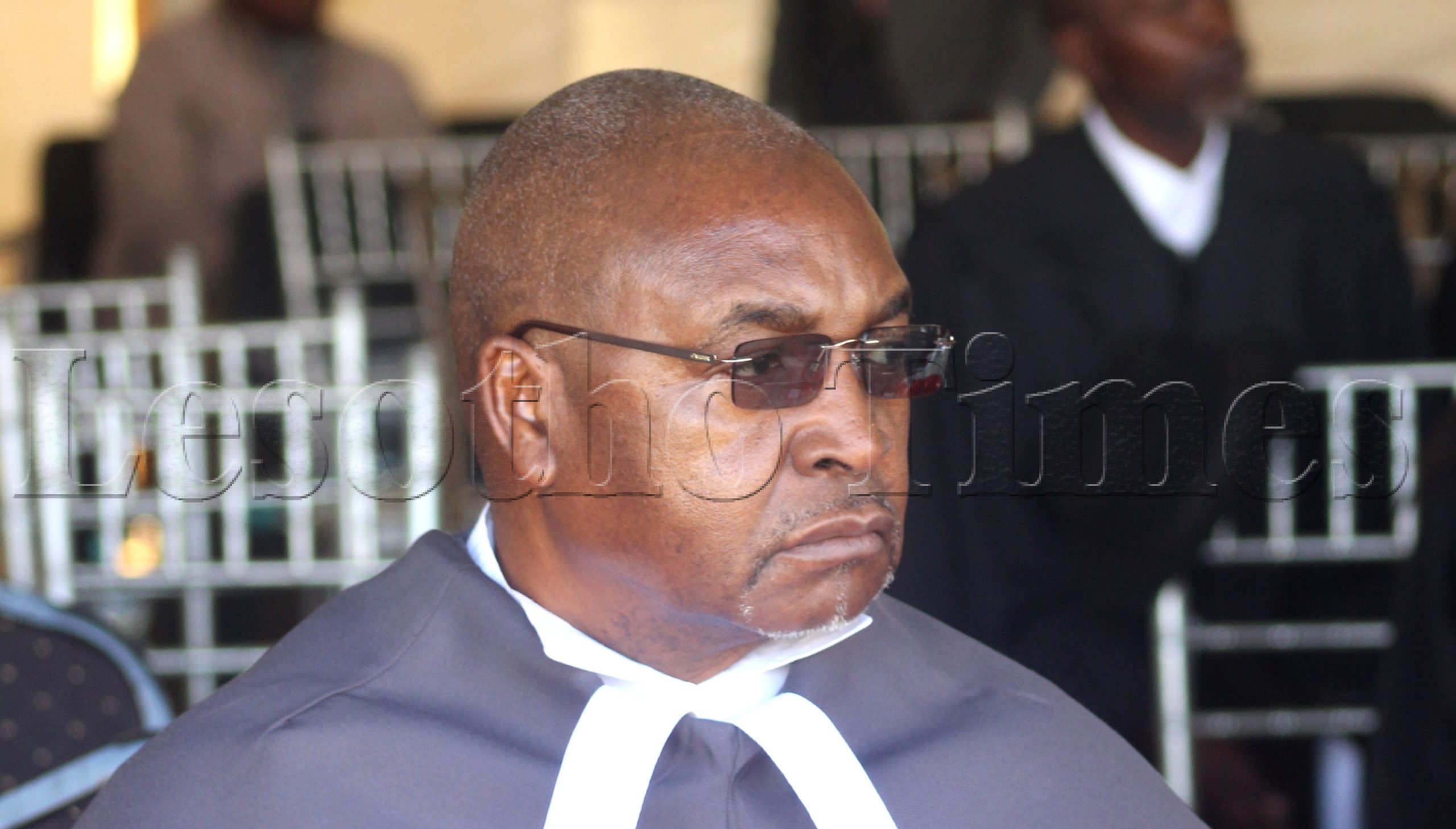
Moorosi Tsiane
FORMER Lesotho Mounted Police Service (LMPS) forensic scientist, Mofo Setloboko, has delivered explosive testimony informing Judge Charles Hungwe that the bombs used in the simultaneous attacks on the homes of former First Lady Maesaiah Thabane and former Police Commissioner Khothatso Tšooana originated from the Lesotho Defence Force (LDF).
Testifying as the state’s 27th witness, Mr Setloboko told the court that on the morning of 27 January 2014, he received instructions from his superior to attend two suspected bombing scenes: one at Ms Thabane’s residence in Moshoeshoe II, and another at Mr Tšooana’s home in Ha Abia.
He said that upon arrival at Ms Thabane’s home, the property was already heavily guarded but he and his team were granted access to begin forensic work.
“When we got to the scene, it was already guarded. We were allowed into the bedroom where the explosion had occurred on the roofing of that room,” Mr Setloboko said.
“The aim of collecting metal pieces was to find those containing bomb residue. I took swabs of the black bomb residue.”
Mr Setloboko told the court that several metal fragments were collected both inside and around the house, all showing signs of explosive residue.
From Moshoeshoe II, his team proceeded to Ha Abia, where he conducted the same examinations.
“We collected metal fragmentary pieces on the floor which had bomb residue. We went to the roofing where we swabbed more residue. We further went outside the house to a radius of 25 meters and collected metal pieces with bomb residue.”
The following day, he analysed all metal pieces retrieved from both scenes. His findings, he said, were alarming.
According to Mr Setloboko, chemical analysis showed that the bomb extracts contained a compound known as bis-2-ethylhexyl, a type of plasticizer used to enhance the power of explosives.
“This type of plasticizer, when added to an explosive, ensures maximum heat and pressure. I discovered that this plasticizer, together with royal demolition explosive (RDX) and high melting explosive (HMX), is used in plastic explosives — and these are military grade,” he said.
He added that the explosives linked to the bombings were consistent with hand-held grenades and grenade-launched ammunition, typically produced by South African defence manufacturers.
However, the witness also said the scenes had been compromised by the presence of both civilians and police officers, which meant some crucial information might not have been properly secured.
During cross-examination, defence lawyer Advocate Letuka Molati — representing former Army Commander Tlali Kamoli — challenged Mr Setloboko’s conclusions, arguing that RDX is also used in civilian demolition operations such as large-scale road works.
But Mr Setloboko stood firm.
“RDX can be found in other explosives of various sizes, but high melting explosives are ordinarily not accessible to civilians,” he insisted.
His testimony is consistent with evidence given earlier by LDF’s Major Pali Hlehlisi in August last year, who told the court that several bombs had gone missing from the LDF armoury around the same time as the attacks.
Kamoli and four other soldiers — Major Pitso Ramoepana, Captain Litekanyo Nyakane, Sergeant Malefane Heqoa and Corporal Mohlalefi Seitlheko — face charges of attempted murder and malicious damage to property in connection with the 27 January 2014 coordinated bombings.
The high-profile case continues tomorrow.
