
—As top judge is accused of legal treachery to position himself to take over plum job
Moorosi Tsiane
Court of Appeal President, Professor Kananelo Mosito, has been accused of engaging in legal skullduggery to position himself to take over as National University of Lesotho (NUL) Vice-Chancellor when the powerful post becomes vacant in July.
This after Prof Mosito, who also serves as NUL’s Pro-Vice Chancellor, filed an urgent application at the High Court this week seeking to block the university’s governing council from proceeding with its current recruitment process for a new Vice-Chancellor.
Professor Mosito states that the current Vice-Chancellor, Prof Olusola Isaac Fajana’s term only ends in July 2026. So, he argues the recruitment process which NUL has started violates the National University of Lesotho Order of 1992 as no vacancy exists yet for the position. He insists recruitment can only legally happen when the position becomes vacant.
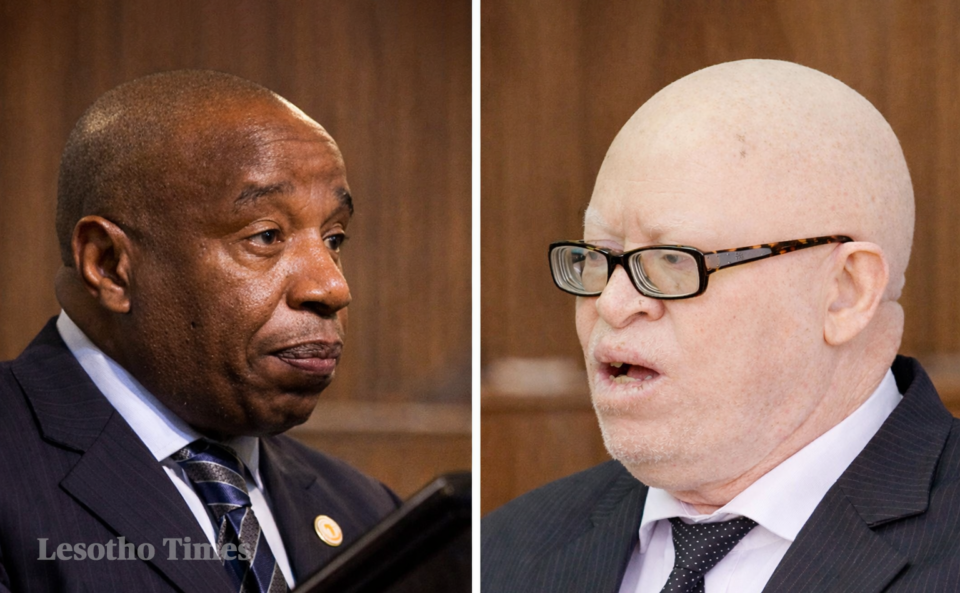
However, the University’s governing council chairperson, Dr Khabele Matlosa, has dismissed Prof Mosito’s application as wholly meritless and self-serving. He challenges Prof Mosito’s legal capacity to bring the application, saying the Court of Appeal judge had failed to explain his interest in bringing the matter to court.
The university’s council had started the recruitment process to prepare for when the post becomes vacant to avoid creating an administrative vacuum when Prof Fajana’s term ends, Dr Matlosa argues.
The only reason why Prof Mosito could be seeking to forestall the recruitment process is to create an opportunity for him to become Acting Vice Chancellor when the position becomes vacant to position himself in good stead to get the job when recruitment begins, states Dr Matlosa.
That all amounts to “abuse of the court process” by a very powerful man bringing the case to be heard by his juniors in the High Court who defer to him as their boss in his capacity as Court of Appeal president, Dr Matlosa argues.
Under Lesotho’s legal system, the man who sits atop the apex court, the Court of Appeal, the final arbiter of all legal disputes in the country, is a virtual part timer who can hold other jobs elsewhere, only returning to hear cases at the appeal court’s twice-yearly sessions. This is unlike in most other legal jurisdictions where the head of an apex court is logically and inevitably a full-time position. It is because of this unusual structure of Lesotho’s legal system that Prof Mosito serves as head of the country’s apex court while also holding a full-time position as a Pro-Vice Chancellor at the country’s premium university.
As Dr Matlosa highlights in his own application, this has now created a conundrum in which Prof Mosito’s own case might end up in the very Court of Appeal that he heads if any of the parties’ appeal. This, Dr Matlosa insists, amounts to legal skullduggery by Prof Mosito to advantage himself.
The Court of Appeal has been proposed for elimination under the national reforms process to be replaced by a Supreme Court, headed by a Chief Justice, as the top court.
The matter was expected to proceed this week but was postponed to Monday after NUL raised a jurisdictional issue. Justice Polo Banyane ruled that the parties must first file heads of argument on those jurisdictional issues first before the matter proceeds.
In his court papers, Prof Mosito argues that the recruitment process is unlawful because it began before a vacancy in the office of Vice-Chancellor had officially occurred.
He says the NUL Council was acting in breach of Section 16 of the NUL Order, which states that a joint committee of Council and Senate may only be appointed to select a Vice-Chancellor “when a vacancy occurs”.
“I seek to restrain and set aside that process on the basis that it is being conducted in direct contravention of section 16(2) and (6) of the National University of Lesotho Order, 1992 (‘the Act’),” Prof Mosito argues.
Central to his argument is Section 16 of the Act, which deals with the appointment of a Vice-Chancellor.
“Section 16(2) of the Act provides as follows: ‘The Council shall appoint a Joint Committee of the Council and the Senate to consider the selection of a candidate for the post of Vice-Chancellor when a vacancy occurs, and the Joint Committee shall submit a report to the Council for consideration’.”
He also cites Section 16(6) defining when a vacancy occurs.
It reads: “The office of the Vice-Chancellor shall become vacant (a) at the expiration of his period of appointment, if the appointment is not renewed; (b) he resigns; (c) the Council, through the Minister, recommends to the Head of State that the appointment be terminated”.
Prof Mosito argues the council had therefore acted prematurely.
“I aver that the phrase ‘when a vacancy occurs’ constitutes a jurisdictional fact upon which the lawful exercise of the power in section 16(2) depends. It is not merely descriptive of timing. It is constitutive of authority,” Prof Mosito argues.
He insists that a future vacancy does not justify the current recruitment actions.
“The fact that a vacancy is anticipated, or even certain to arise at a future date, does not satisfy the statutory requirement that it must have occurred. A jurisdictional fact must exist in law, not in expectation.
“To treat a future vacancy as present is to collapse the statutory sequence and to substitute administrative convenience for legislative command.”
According to him, the current Vice-Chancellor, Prof Fajana’s term only ends in July 2026.
“The incumbent Vice-Chancellor’s fixed term is due to expire on 31 July 2026, upon which date a vacancy will arise by effluxion of time in terms of section 16(6)(a) of the Act,” Prof Mosito states.
However, he says recruitment began earlier than allowed.
“Notwithstanding that the statutory trigger for action under section 16(2) is ‘when a vacancy occurs,’ the Council has initiated steps towards the appointment process prior to the occurrence of such vacancy,” he argues.
He also relies on Section 17(4) of the Act.
“Section 17(4) provides: ‘The Pro-Vice-Chancellor shall act as Vice-Chancellor when that post is vacant, or when the Vice-Chancellor is absent or unable to act, and shall, when so acting, be entitled to perform all the functions of the Vice-Chancellor’.”
He says this removes urgency for early recruitment.
“On a proper construction of the Act, section 17(4) makes express and sufficient provision for continuity in the governance of the University upon the occurrence of a vacancy.
“In these circumstances, the Act does not contemplate, nor does it require, any anticipatory measures by Council to avert a perceived administrative vacuum.
“The existence of section 17(4) negates any suggestion of ‘practical necessity’ to initiate or advance the appointment process prior to the occurrence of a vacancy.”
Prof Mosito accuses the Council of acting unlawfully.
“By reversing or collapsing this sequence, the Council has acted prematurely, unlawfully, and in excess of its statutory powers.
“I aver that such conduct is ultra vires, procedurally improper, and liable to be set aside under the principle of legality.
“The defects are not formal or technical. They go to the very legality of the process.”
He also stresses the role of the Joint Committee (NUL Senate and Council).
“The Joint Committee contemplated in section 16(2) is not an informal or advisory arrangement. It is a statutory body established to exercise a defined public/statutory power—namely, the consideration and recommendation of a candidate for appointment.
“Its constitution marks the commencement of the statutory appointment process… it may only lawfully occur once the jurisdictional fact prescribed by the statute—namely, the occurrence of a vacancy—has materialised.”
He claims attempts to resolve the matter outside court had failed.
“As appears from a letter dated 12 November 2025… the Directorate on Corruption and Economic Offences (DCEO) attempted to intervene, but the first respondent ignored it.
“I also attempted to engage the Registrar… and attempted to involve the Minister of Education… He did not respond. All attempts have been made to bring the situation under control.”
NUL, however, strongly opposes the application.
In his affidavit, Matlosa dismisses Prof Mosito’s arguments.
“The Applicant lacks the requisite standing to institute these proceedings based on several grounds of exclusions addressed categorically below,” states Dr Matlosa.
He argues Prof Mosito has no legal right to bring the matter.
“It is trite law that locus standi requires a direct and substantial interest in the subject matter of the litigation; an interest that is real, not abstract, academic or hypothetical,” he states, insisting that Prof Mosito had failed to justify his interest in the matter.
He further disputes Prof Mosito’s reliance on Section 17(4).
“The Applicant’s reliance on section 17(4)… is misplaced because the provision does not confer a personal right or entitlement to act.
“The provision merely creates a contingent statutory function to act only upon the occurrence of a vacancy… and the latter is not to be staged, manufactured or enabled.”
NUL insists the process is lawful.
“At the institution of this application proceedings, there is no vacancy in the office of the Vice Chancellor to warrant invoking of section 17(4).
“The recruitment process is prospective and preparatory in nature. Therefore, the Applicant’s alleged interest is premature.”
He further accuses Prof Mosito of acting in self-interest.
“The locus standi instead masquerades the real basis of the application which is self-interest and abuse of process.
“The application is fundamentally driven by self-interest because the Applicant’s (Mosito) desire is to position himself to act as Vice-Chancellor and secure strategic advantage.
“A court of law is not a vehicle for one to advance career ambitions, or engineer institutional outcomes for personal benefit.
“This application is therefore mala fide in effect, if not in form and should be dismissed with costs on a punitive scale.”
Dr Matlosa also challenges the court’s jurisdiction.
“The Applicant is not only the Pro-Vice Chancellor… he is also the President of the Court of Appeal… His involvement… may ultimately reach the appellate court which in effect creates a structural conflict.
“There is a reasonable apprehension of bias because… judges of the High Court may feel constrained in their decision making. Justice must not only be done but be seen to be done,” he adds.
The university further argues the matter belongs in labour court.
“What he has presently is an interest to act which… is squarely an employment issue determinable by the labour court.”
The case returns to court next week for argument of the jurisdictional issues.
