
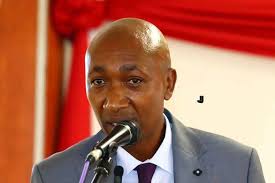
…PS Tšoele aappeals for patience
…Says doing all he can to resolve crisis
Rethabile Pitso/Hopolang Mokhopi
Local Government, Chieftainship, Home Affairs and Police Principal Secretary, Mpopo Tšoele, has appealed for patience from citizens while his ministry seeks lasting solutions to address the long running, debilitating passport crisis which has hamstrung citizens desperate to seek opportunities in South Africa.
The ministry has been struggling to issue passports to citizens with a backlog now standing at 51 000 passports. Frustrated and desperate citizens have continued to besiege the passport office to try and access the critical travel documents. This to either seek new job opportunities in South Africa or for those already employed but with expired documents, renew them to return to their jobs in that country.
Because of the lack of job opportunities in Lesotho, tens of thousands of Basotho rely on South Africa for work prospects. Others simply cross the long, largely unguarded border illegally to do menial jobs in that country. But for those legally employed under the Lesotho Exemptional Permit which allows one to reside, work, study, or run businesses legally in South Africa, they must always keep valid passports.
The passport crisis has nonetheless endured for years now.
Mr Tšoele said the passport issuance crisis dated back to 2021 during the COVID-19 lockdown period when budgets were cut because travel was low. When travel spiked again and demand for passports increased, the budgets were not adjusted to cater for that new reality resulting in a backlog of passports.
In addition to inadequate budget allocations, he further attributed the inefficiencies and challenges in issuing passports to outdated printing equipment and to corruption by officials who often demand bribes from passport applicants.
Over the Easter holidays, passport production services were temporarily halted after one of the department’s printers broke down, leaving only a single, slow machine operational.
When services resumed on Tuesday this week, the Home Affairs office in Maseru was overwhelmed by a surge of applicants and collectors, many hoping to travel to neighbouring South Africa for work and other commitments.
Mr Tšoele spoke to the Lesotho Times amid the long queues of frustrated applicants at the ministry’s offices.
He revealed that although progress had been made, the department was still grappling with a backlog of 51,000 passports. Still, the figure is significantly down from 115,000 when he assumed office in January.
“When I was appointed, one of my first concerns was understanding why people were sleeping outside Home Affairs offices waiting for passports,” Mr Tšoele said.
“The response from management was that the problems began during the lockdown, when the budget was reduced due to limited travel. After COVID-19, demand increased again, but the budget was never adjusted accordingly.”
Mr Tšoele explained that aging printers further compounded the crisis, drastically reducing production capacity.
“Previously, the department printed about 2000 passports per day. However, due to equipment inefficiencies, output dropped to around 400 per day. This created a daily shortfall of 1600 passports, which accumulated into a massive backlog over time.”
The delays, he added, created fertile ground for corruption.
“The system became a concrete jungle where desperate applicants, eager to obtain passports, resorted to bribing officials,” he said.
Mr Tšoele also cited procurement challenges, particularly regarding essential consumables such as ink and printing materials.
“You may have seen a letter circulating on social media suggesting that if I did not sign a certain commitment, consumables would not be available by Easter. I was being pressured to approve a procurement process without proper evaluation.
“I nearly made that mistake, but my financial advisor cautioned me against signing before due process was followed.”
To stabilise operations, Mr Tšoele said the ministry has implemented several interim measures, including deploying additional staff at payment points, installing new cameras to combat corruption and increasing the number of data-capturing computers.
“These interventions have improved front-office operations, but the core challenge remains at the production centre, where outdated machinery continues to hamper efficiency,” he said.
He added that plans were underway to procure new printing equipment by 1 May, which is expected to significantly improve output and reduce the backlog.
“The current machines are unreliable — they spill ink, jam passports during printing and frequently halt production,” he said.
To combat corruption, the ministry has enlisted police support to monitor operations, while district administrators have been roped in to assist with passport distribution outside Maseru.
Mr Tšoele acknowledged that the Department of Home Affairs’ current budget of approximately M107 million remained inadequate, especially given its outstanding debts.
“About M15 million from the current budget will go towards settling previous obligations. While the allocation is not ideal, it should help restore some level of order. We have been advised to utilise available funds and seek additional support if necessary,” he said.
He appealed to Basotho for patience and understanding.
“It is important for citizens to understand that when someone applies for a passport today, there are already 51,000 applications ahead of them,” he said.
“I sincerely apologise for the inconvenience and ask for forgiveness for the shortcomings experienced during this period.”
Meanwhile, Director of Passport Services, Mpiko Rafono, echoed the concerns, saying the department’s challenges were rooted in long-standing financial and operational constraints.
He said budget cuts during the 2021/2022 financial year, at the height of the pandemic, significantly affected passport procurement.
“As a result, we can now only procure about 60,000 passports annually,” he said.
Mr Rafono explained that when the system was first introduced, the department procured about 317,000 passports with a budget of M23 million, at a time when demand was still low.
However, funding has remained stagnant over the years, despite rising demand. He said at least M50 million dedicated solely to the printing of passports would be required to restore efficiency.
Reflecting on past performance, Mr Rafono said passport turnaround times were once as short as three days.
“In 2015, applicants received their passports within three days. Even as far back as 2013, applicants were given clear collection dates, with penalties for late collection,” he said.
He added that aging equipment which he said had been in use since 2013, continues to break down frequently, further disrupting production.
“Operations were recently halted over Easter due to a machine breakdowns, and production has also been affected by shortages of essential consumables such as ink and printing ribbons,” he said.
