
Mohloai Mpesi
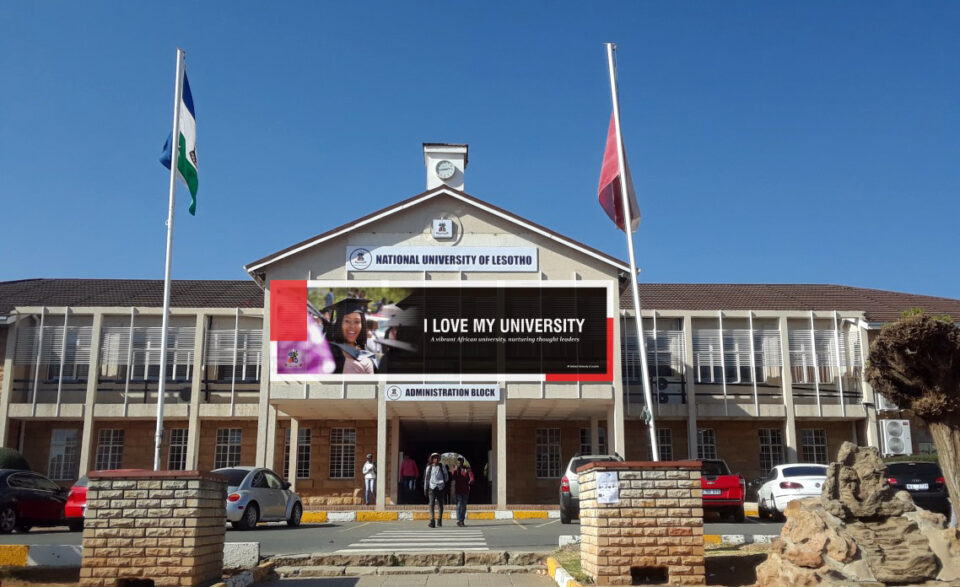
THE National University of Lesotho (NUL) is facing severe infrastructural decay that threatens the safety of students, parliament has been told.
The university, widely regarded as the pride of the nation and the largest in the country, reportedly has buildings in such poor condition that they pose serious hazards.
The situation came to light during the university’s presentation to the National Assembly’s Social Cluster Portfolio Committee, chaired by Mokhothu Makhalanyane, this week. The management appeared before the committee as the Ministry of Education and Training was summoned for consultations on the Annual Budget 2026/2027.
The ministry team was led by Minister Professor Ntoi Rapapa, accompanied by Principal Secretary Ratšiu Majara, Chairman of the Teaching Service Commission Ratokelo Nkoka, and Deputy Principal Secretary Refiloe Kepa. Also present were NUL Pro-Vice Chancellor, Professor Kananelo Mosito, and NUL Vice-Chancellor, Professor Olusola Fajana.
Prof Fajana expressed deep concern over the state of the university’s infrastructure, saying students frequently complained about the poor conditions. He highlighted dilapidated laboratory floors and the library, which suffered a fire in 2021 shortly after he assumed office.
“Some of our buildings are over 50 years old. With the resources currently available, we cannot maintain all facilities to avoid collapse. The science block and lab floors for Environmental Health have failed. The library fire in 2021 was caused by outdated electrical cabling that had been in place for over 50 years,” Prof Fajana said.
He also said lecture halls were equally uncomfortable for students.
“Sitting on hard surfaces with exposed metal is not acceptable for a university of our status. Replacing all lecture hall seats will take at least five years given our current resources. We are trying to do things in phases, but students remain dissatisfied, which affects the learning environment and the university’s reputation.”
The Vice-Chancellor attributed the infrastructural decay to insufficient funding from the government, which he said limited the university’s ability to implement maintenance programs.
“We are losing on all fronts due to inadequate resources. Special grants are needed to upgrade infrastructure. Procurement delays are a symptom, but the real issue is the lack of cash flow,” he said.
NUL’s Head Bursary Officer, ‘Masechaba Mantsoe-Ntaopane, outlined the 2025/2026 financial situation, revealing a drastic cut in subvention funds.
“We requested M297 million for subvention but received only M90.5 million, which was added to our salary budget. After covering salaries and utilities, there is nothing left for maintenance. This explains the current state of our infrastructure,” Ms Mantsoe-Ntaopane said.
For the 2026/2027 financial year, NUL projects a total budget of M607.3 million, with internal revenue expected to generate over M272 million.
“It is extremely difficult to operate a higher learning institution where technology is compromised, laboratories are under-equipped, and even lecturer quality suffers due to budget constraints,” she said.
Mr Makhalanyane stressed the urgent need to address NUL’s infrastructural problems.
“This is our oldest and largest university. We must act decisively to secure its future. Education is crucial for national development, and we cannot invest in trivial matters while our universities suffer,” Mr Makhalanyane said.
He also referenced a visit by lecturers from the National Health Training Centre (NHTC), who highlighted severe resource shortages affecting practical learning, emphasizing the moral responsibility to provide proper facilities.
Prof Rapapa said his ministry was engaging with the Ministry of Finance and Development Planning to ensure higher learning institutions were included in capital investment programming through grants and loans.
“We are working to ensure that universities, including TVET institutions, are properly included in the government’s capital investment plans,” Prof Rapapa said.
