
Moorosi Tsiane
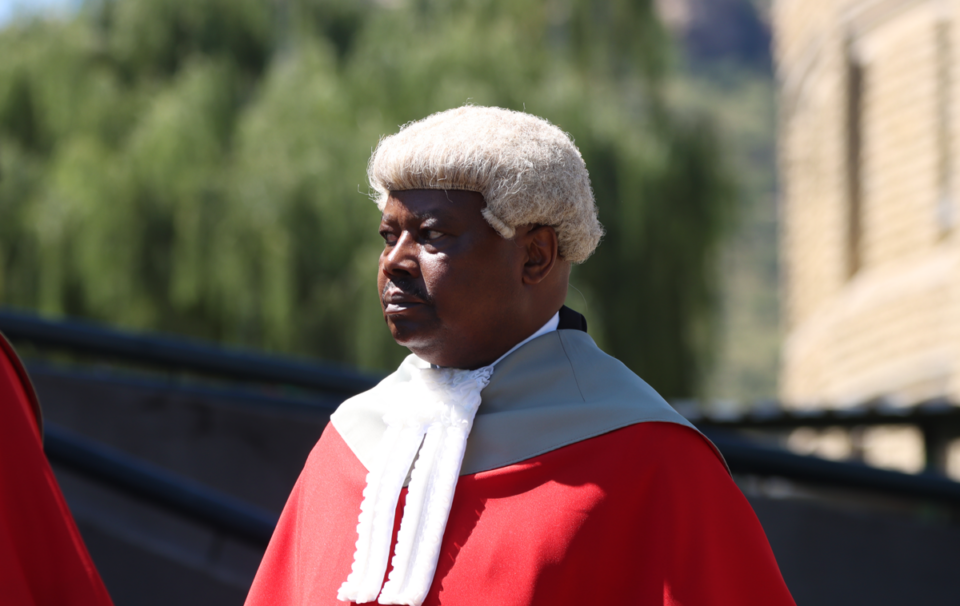
CHIEF Justice Sakoane Sakoane has delivered a blistering rebuke of both the Lesotho Defence Force (LDF) and the police, making it clear that his court will not tolerate incompetence, collusion or deliberate tampering with evidence by those entrusted with the country’s security.
Justice Sakoane was visibly angry when a case of two soldiers accused of the 9 May 2014 murder of Lisebo Tang proceeded before him on Tuesday.
He raised serious concerns over the handling of crucial exhibits in the murder trial of the two LDF officers, openly questioning whether the conduct of the soldiers, and the police who received the exhibits, was calculated to defeat the ends of justice.
The accused, Sergeant (then Corporal) Tjekane Sebolai and Corporal (then Private) Selone Ratšiu, are charged with the fatal shooting of Ms Tang outside the Ha-Leqele residence of then LDF commander Lieutenant General Tlali Kamoli. Tang died at the scene, while her companion, Tšepo Jane, survived with serious gunshot wounds. Their vehicle was also found to have been struck by 24 bullets. The duo is also charged with Mr Jane’s attempted murder and damage to his vehicle.
The two soldiers have claimed they were acting under orders to “eliminate” perceived threats.
After the Crown concluded its oral submissions on Tuesday morning, Justice Sakoane turned sharply to State counsel, Advocate (Adv) Motene Rafoneke, demanding guidance on how the court should deal with disturbing revelations that LDF officers had tampered with firearm exhibits.
“Counsel, there is this issue of the tampered exhibit in this matter. What would you suggest I write in the footnote of the judgment regarding officers who tampered with those exhibits?” Justice Sakoane asked.
He warned that interference with evidence by members of the security forces was not only criminal but posed a grave danger to society.
“It is a serious criminal offence to tamper with exhibits by security personnel on whom the security of this country lies. If we have untrustworthy police and army officers, it means they can even conspire and fabricate evidence against innocent people, and such people would stand the risk of being hanged based on fabricated evidence,” said a visibly irate Justice Sakoane.
The issue of tampering surfaced during the defence case in November last year, when Warrant Officer Class II (WOII) Liau Jase testified that the firearms produced in court did not match the bullet cartridges recovered from the crime scene.
WOII Jase told the court that on the morning following the shooting, Captain (then Lieutenant) Moeletsi collected two rifles allegedly used in the attack, claiming he was taking them to the police for ballistic testing.
However, Justice Sakoane noted with concern that Capt Moeletsi did not take the accused soldiers to the police. Instead, he was accompanied by Staff Sergeant Mokoena Mokoena to the police station, an officer who was not present at the shooting scene.
Equally troubling to the court was the fact that it was Staff Sgt Mokoena, and not the accused soldiers, who gave a statement to the police.
“I am not told where these two soldiers took the firearms. I asked Warrant Officer Jase about this and he couldn’t explain. This is defeating the ends of justice and it is a very serious crime,” Justice Sakoane said.
The Chief Justice went further, openly questioning whether the conduct pointed to a deliberate cover-up.
“Maybe there are some other cases where these things are happening to cover up crime,” he remarked.
Justice Sakoane was equally scathing about the conduct of the police, expressing disbelief that officers would accept a statement from a mission commander who was not a perpetrator, without insisting that the alleged shooters themselves account for the weapons.
“So the mission commander comes to the police to give a statement without the perpetrators, and they do not send him back? They take his statement and that’s it? What is really happening here? Who is fooling who exactly?” he asked.
In a clear signal that the court would not look the other way, Justice Sakoane asked Adv Rafoneke whether he should order the Director of Public Prosecutions (DPP) to institute criminal proceedings against those involved in tampering with the exhibits. Adv Rafoneke agreed that such a directive would be appropriate.
Justice Sakoane further indicated that he was considering ordering the destruction of the tainted firearms in his presence, underscoring the seriousness with which the court views the matter.
Sebolai, Ratšiu’s fate hangs in the balance
During closing arguments before Justice Sakoane, the Crown insisted that Ms tang killing was deliberate, arguing that the pair deliberately carried out a deadly shooting spree intended to kill.
Adv Rafoneke, painted a grim picture of what he described as a calculated and merciless attack.
“My Lord, the manner in which this shooting was executed shows a clear intention to kill, looking at the number of bullets used,” said Adv Rafoneke.
“This was a brutal shooting that took no regard for whether people would survive or not.”
He told the court that evidence firmly placed both accused at the centre of the deadly attack, arguing that the volume of gunfire demonstrated a coordinated and deliberate assault.
“There is no doubt that both accused participated in the crime. The evidence shows that one fired 14 bullets while the other fired 10”, he submitted, urging the court to convict them of murder with direct intent.
The prosecution dismissed the defence’s claim that the shooting was triggered by a military “red alert” allegedly issued following bomb attacks targeting senior political and police figures at the time.
In their defence, Sebolai and Ratšiu maintained that they were acting under military instructions after being informed that a vehicle resembling the one they fired at had been linked to bombings at the Ha Abia residence of then Police Commissioner Khothatso Tšooana and at Moshoeshoe II, where then Prime Minister Thomas Thabane’s partner, Liabiloe Ramoholi (now ‘Maesaiah Thabane), resided.
However, Adv Rafoneke rubbished the red alert narrative, describing it as a desperate attempt to mask an unlawful killing.
He pointed out that the claim contradicted Sebolai’s own testimony, in which he stated that they had been briefed by then Lieutenant (now Captain) Moletsane that police were planning to arrest Kamoli and that they were instructed to prevent such an arrest.
“There was never a red alert. Even the current army commander, Lieutenant General (Mojalefa) Letsoela, told this court that there is no such procedure because a red alert must be issued by the sitting Prime Minister on the advice of the army commander. The red alert story is simply a cover-up,” Adv Rafoneke argued.
He stressed that the soldiers knew the vehicle was occupied when they opened fire.
“There was a clear and direct intention to kill the occupants of the vehicle. They also intended to damage property. They should be found guilty of murder, attempted murder and malicious damage to property,” he said.
Defence lawyer, Adv Sello Tšabeha, countered that his clients were acting under military command and believed they were responding to a legitimate security threat.
He insisted the red alert was genuine and that the soldiers had been ordered to track a white vehicle suspected of being used to plant bombs.
“The vehicle they shot at matched the description they had been given,” Adv Tšabeha said, adding that its position near a maize field heightened suspicion.
He argued that the soldiers initially attempted to apprehend the occupants peacefully and only fired to disable the vehicle.
“They fired a warning shot, and when the vehicle attempted to flee, they shot at the wheels. Unfortunately, some bullets missed,” he said.
Adv Tšabeha conceded that the shooting had tragic consequences but argued that his clients lacked the direct intention to kill.
“There was negligence, not intention. The appropriate verdict is culpable homicide, not murder,” he submitted.
After hearing both sides, Justice Sakoane reserved judgment.
“I must analyse the evidence together with my assessors. Judgment will be delivered on 11 May 2026. The accused should continue to observe their bail conditions.”
With the ruling date set, Sebolai and Ratšiu now face an anxious wait as the court prepares to decide whether Tang’s death was the result of a tragic mistake or a calculated killing. Should they be found guilty, their bail will be revoked, and they will await sentencing in Lesotho Correctional Service (LCS) custody.
