
Mathatisi Sebusi
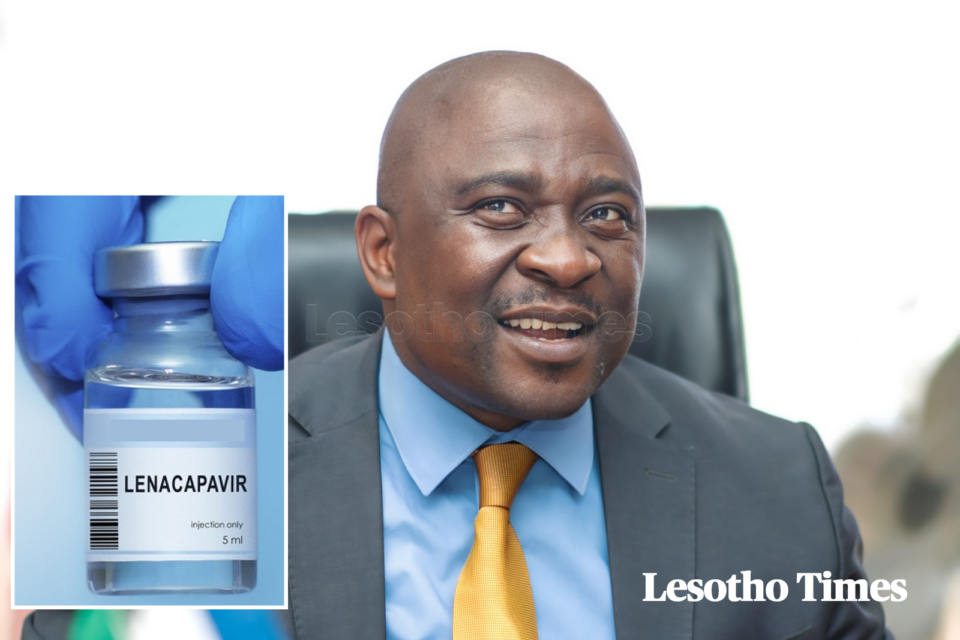
THE Ministry of Health will next month receive the first batch of 7,000 doses of the HIV prevention drug, Lenacapavir, from the United States (US) government.
An additional consignment from the Global Fund is expected to follow thereafter.
This was revealed by the Minister of Health, Selibe Mochoboroane, in an interview with the Lesotho Times this week. He said the ministry was ready to administer the drug at selected health facilities once it arrives in the country.
“We are expecting 7000 doses of lenacapavir in February. This will be followed by other consignments coming from the Global Fund, and once they arrive, they will be piloted in selected health facilities,” Mr Mochoboroane said.
The development follows negotiations and the signing of an agreement in October between the Ministry of Health and the US government to pilot a newly developed HIV prevention drug that requires injection only twice a year.
Mr Mochoboroane said once the drugs arrive, the ministry will begin rolling out lenacapavir, a twice-yearly injectable developed by US-based pharmaceutical company Gilead Sciences. The initiative forms part of a groundbreaking HIV prevention programme under the President’s Emergency Plan for AIDS Relief (PEPFAR) and will be co-funded by PEPFAR and the Global Fund.
He said the agreement marks renewed US interest in supporting Lesotho’s HIV response following previous funding withdrawals.
Mr Mochoboroane explained that during a visit to the US, he met with government representatives, where discussions focused on Lesotho piloting the administration of lenacapavir.
“We agreed that the US government will introduce this kind of vaccine. The US also proposes the ‘America First Global Health Strategy,’ which is built on three pillars: make America safe, make America great, and make America prosperous.”
He explained that the “make America safe” pillar includes supporting countries like Lesotho in preventing infectious diseases to reduce the risk of global spread. However, he noted that US assistance is conditional on countries’ performance in previous aid programmes such as PEPFAR.
Mr Mochoboroane highlighted that Lesotho has exceeded global HIV targets, strengthening its eligibility for inclusion in the lenacapavir pilot.
“Globally, the HIV target is 95-95-95 by 2030. This means 95 percent of people living with HIV should know their status, 95 percent of those who know their status should be on treatment, and 95 percent of those on treatment should have suppressed viral loads.
“We assessed where Lesotho stands, and we have surpassed the global target — we are at 97-97-99.”
He added that by 2030, countries are also expected to reduce new HIV infections by 90 percent. Lesotho currently stands at 87 percent, showing significant progress toward that goal.
Mr Mochoboroane said Lesotho was also selected for the lenacapavir pilot because of its strong tuberculosis (TB) response.
“Global targets require countries to reduce the TB burden by 90 percent by 2030. Lesotho is on track, increasing TB notifications and ensuring patients are placed on treatment. This puts us in a strong position — among the 16 countries selected by the U.S. government to continue working with,” he said.
In August 2025, the US Department of State announced plans to make lenacapavir available in countries with high HIV burdens, including Lesotho.
According to the department’s official statement, lenacapavir is a highly effective HIV prevention medication that requires administration only twice per year. The rollout will prioritise pregnant and breastfeeding women, who face a higher risk of HIV transmission.
A large-scale clinical trial demonstrated remarkable effectiveness, with more than 99 percent of participants remaining HIV-negative while on lenacapavir.
The initiative will be jointly funded by the US government and the Global Fund, aiming to reach up to two million people by 2028. Allocation will depend on each country’s HIV burden and capacity to distribute and administer the drug effectively.
“In the coming months, PEPFAR will collaborate with partner countries to develop detailed rollout strategies, prioritising high-risk groups, especially mothers and infants,” the statement said.
The US Senior Official for Foreign Assistance, Humanitarian Affairs and Religious Freedom, Jeremy Lewis, had at that time said lenacapavir’s twice-yearly dosage offers major advantages.
“The dosing schedule increases convenience and adherence, helping reduce transmission rates and lower treatment costs.
“The U.S. will continue partnering with countries with large HIV epidemics to co-develop targeted distribution plans, with a strong emphasis on preventing mother-to-child transmission,” Mr Lewis said.
In addition, Global Fund Executive Director, Peter Sands, emphasised the importance of fast-tracking access to medical innovations like lenacapavir.
“We must ensure breakthrough tools are introduced quickly, affordably and where they will have the greatest impact. By focusing on regions where lenacapavir can make the biggest difference, and working closely with the US and Gilead, we can help countries integrate this innovation into their HIV prevention programmes.
“This will reduce new infections and accelerate progress toward self-reliance and epidemic control.”
Mr Mochoboroane also said the US government will also support Lesotho in strengthening human resources for health, particularly by increasing the number of frontline healthcare workers.
“We are waiting for a memorandum of understanding to start a new five-year programme. We have already discussed the operational plan.
“People who will be supported by US funding as our human resource will be gradually absorbed into the government system. We do not have many positions for social workers, professional counsellors and paramedics, but we have started the process to ensure these positions are available within the government establishment to avoid relying on personnel provided by development partners.
“This time around, we will be the ones saying what we need, and the human resource will be paid according to the government scale,” Mr Mochoboroane said.
