
…police funding crisis exposed
…as less than a third of reported cases reach court
..due to lack of money for investigations
…while violent crime continues to soar
Mohloai Mpesi
LESOTHO is in the grip of a worsening crime crisis, with statistics revealing a chilling gap between the number of reported cases and those seeing their day in court.
Financial constraints stand out as the major factor impeding police investigations.
Between July 2024 and June 2025, 5958 criminal offences were recorded nationwide, yet only 1620 cases, just over 27 percent, have made it to court.
The rest, including serious crimes like 1645 sexual offences, 2231 stock theft cases, 697 robberies, and 687 murders, remain unresolved.
Police say they are hamstrung by inadequate resources, lack of forensic infrastructure, and poor public cooperation, all of which together severely undermine the pursuit of justice.
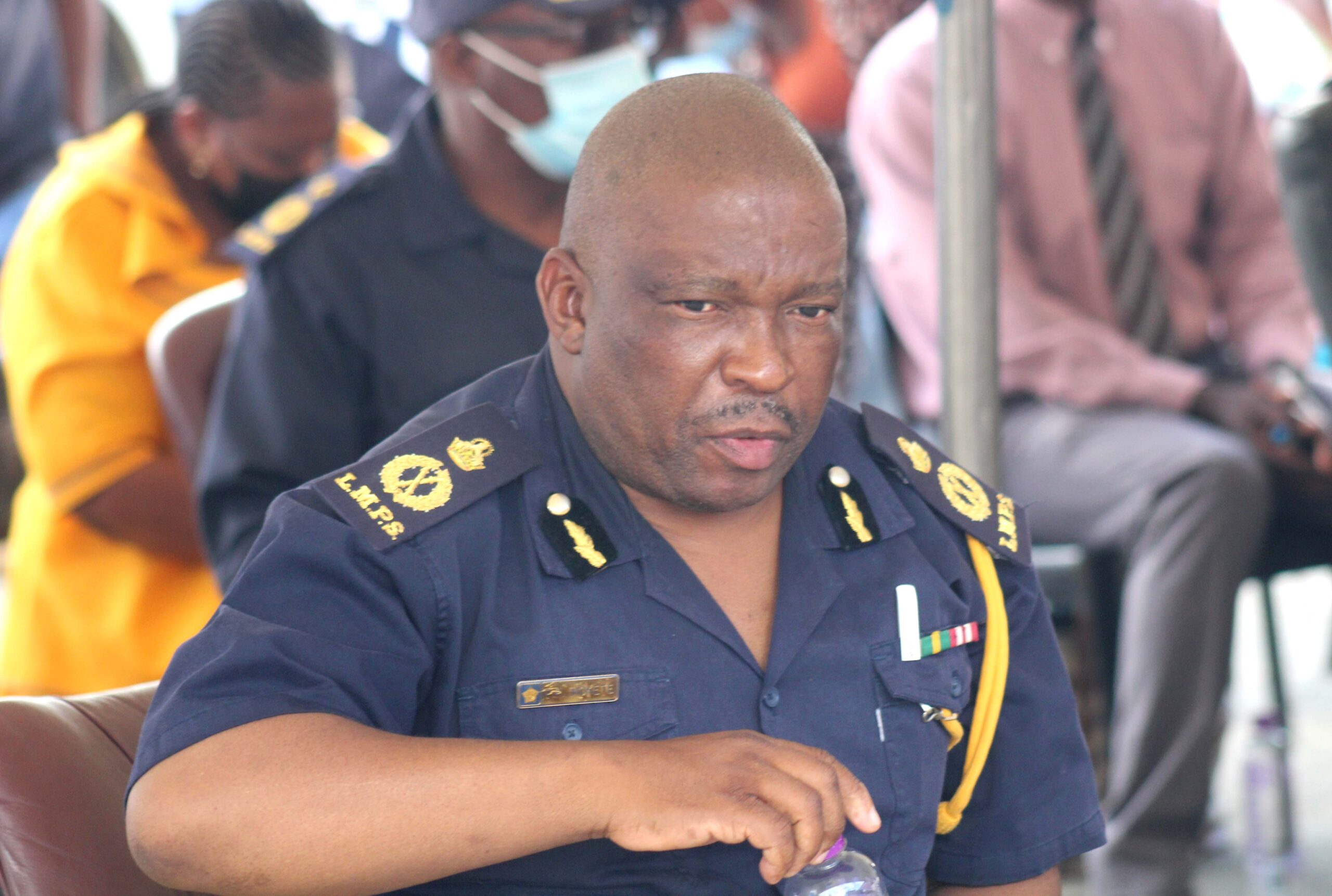
Deputy Commissioner of Police (DCP) Paseka Mokete, who heads the Lesotho Mounted Police Service’s (LMPS) Criminal Investigation Division (CID), told the Lesotho Times this week that the police cannot mount thorough investigations without sufficient funding.
“Investigations are expensive. From collecting forensic evidence, transporting witnesses, to obtaining expert opinions – it all requires money which we simply do not have.”
He also said the LMPS does not have a DNA lab in the country. So for cases requiring forensic testing, samples must be sent to South Africa, often causing months, if not years, of delay even when funds are made available.
Detection
DCP Mokete explained that the low rate of cases reaching court is due to several interlinked challenges, primarily stemming from limited resources.
Between January and May 2023, up to 4845 cases were reported but only 697 were detected, while for the same period in 2024, about 4960 cases were reported with 880 detected.
The figure for July 2024 to June 2025 shows a marginal improvement, with 5958 criminal offences recorded and 1620 taken to court.
Still, the vast gap between reported and prosecuted cases reflects a crisis within the criminal justice system.
“The public assumes that when a crime is reported, the suspect must automatically be prosecuted,” DCP Mokete said.
“But you do not take cases to court simply because they have been reported; you only take thoroughly investigated cases to court. Most cases drag on because we do not have strong enough evidence, and that is due to lack of resources.”
Gathering evidence involves a range of activities such as visiting crime scenes, obtaining expert analyses, and transporting suspects and witnesses, all of which require money, he added.
“Investigation is not a simple process. It is one of the most complex functions in the police service and without funding, we are crippled.”
Uncooperative witnesses
According to DCP Mokete, another major impediment to effective policing is the public’s reluctance to assist police with information or testimonies.
He cited fear of reprisals from criminals, coupled with the absence of a witness protection programme, as key factors that make citizens reluctant to come forward.
“There are many factors contributing to low detection rates, and one of them is the unwillingness of witnesses to cooperate. People are afraid because they know that once they testify, the suspect could return and harm them,” he said, adding that Lesotho does not have a formal law or programme to protect witnesses.
“Even if we had the legal framework, we do not have the resources to put people under protection, relocate them, or create secure shelters. Witnesses are left exposed,” he said.
Sometimes critical witnesses are forced by circumstances to leave the country, particularly to look for work in South Africa.
“If that happens, we do not have the means to bring them back for trial. And without them, cases collapse since courts require concrete, admissible evidence, not speculation.”
Dismissing the widely held belief that police leak information to criminals, DCP Mokete said such thinking discourages cooperation from members of the public.
“That narrative benefits criminals. People must help us fight crime. If they do not, offenders will continue to commit multiple crimes with impunity,” he said.
Funds
DCP Mokete further highlighted that investigations, especially complex ones, required significant investment without which even obvious suspects could walk free due to lack of evidence.
“Investigations are expensive. If someone is shot, we must collect ballistic evidence. If we find bullet shells, we need to test if they match a weapon and that means we need forensic services. If we require DNA evidence, we must send samples to South Africa because Lesotho does not have a DNA lab. That process alone delays justice for years,” he said.
Many cases remain unresolved simply because there is no money to pursue the necessary forensic trails or bring in expert testimony.
“We cannot just take a case to court for the sake of it. We must have evidence linking the suspect to the crime. But with the current budget constraints, we cannot meet those requirements, which affects our ability to prosecute,” DCP Mokete said.
No witness protection, no evidence
In some cases, courts release suspects, not because they are innocent, but because crucial witnesses are unavailable or the evidence is weak, he said.
“Sometimes a key witness disappears. Maybe they would have left the country, or they fear for their safety. Without that testimony, our case falls apart. Meanwhile, the public thinks the police are incompetent, but the truth is we lack the means to deliver justice.”
He gave an example of how even willing witnesses can be lost.
“Imagine a witness who witnessed a murder but must move to South Africa (to work) to feed their children. Are they going to stay in Lesotho for 10 years waiting for a trial? And when we want to bring them back there is no money so the case collapses and the suspect walks.
“When we finally get to court, the judge must make a ruling based on facts. The court does not accept rumours or assumptions. So, if we fail to bring proper evidence, we lose the case,” he added.
Stock theft
DCP Mokete acknowledged that stock theft was one of the most pressing issues facing the country, with over 2200 cases reported in a single year. However, he said that even in this area, police efforts were undercut by lack of resources.
“The government has made some progress. Each district now has a vehicle assigned specifically to address stock theft. But challenges remain,” he said, stressing that accusations alone were not enough to effect an arrest.
“Villagers may believe they know who stole their livestock, but we cannot arrest someone based on public opinion. We need physical evidence. Without it, the courts will not convict. And gathering that evidence is a difficult task without adequate resources,” DCP Mokete said.
Expertise
Asked whether the LMPS had sufficient investigative expertise, DCP Mokete said the skills were there, but they were underutilised due to lack of equipment and support.
“We have trained investigators, but they are limited by what they can do without funding. For example, we do not have the tools to carry out DNA analysis or advanced forensics so even when we have experts, their hands are tied.”
He cited the example of South African forensic investigator Colonel Johannes Mangena whom he said had attended numerous courses to build his capacity. Col Mangena has worked on several Lesotho cases, assisting the LMPS, including the murders of former First Lady Lipolelo Thabane and former army commander Lieutenant General Maaparankoe Mahao.
“We need more officers like him, but training requires money. That is the reality,” he said, noting that that modern policing demanded a wide range of skills.
“We need financial analysts to handle fraud cases. We need firearms analysts who can determine who owns a gun and where it has been used before. These professionals must be equipped to convince a court, but we lack the tools to support them.”
Delays in court proceedings also undermined police work, he added.
“Look at the case of Tlali Kamoli. The alleged offences happened in 2014 and 2015 but the cases only started in 2017 and they have still not reached finality. What message does that send to criminals?” he asked rhetorically, warning that such delays eroded public trust and emboldened offenders.
“When criminals notice that cases are going unresolved for years, it gives them confidence to continue breaking the law.”
Capacity building
DCP Mokete said the police must undergo capacity building initiatives to stay ahead of evolving criminal tactics.
“We need to invest in our people. Every year, we draft a policing plan that includes public input but for those plans to work, we must have trained staff and the necessary equipment,” he said.
He emphasised the need for continuous training, especially in areas like cybercrime, fraud, and forensic analysis.
“Training is essential, not optional, but again it comes down to funding.
“The fight against crime is not the police’s responsibility alone. The public must cooperate. The courts must be efficient, and the government must fund the justice system. Without that, we are fighting a losing battle.”
He added: “You are fighting a battle when you investigate a case and collect evidence against all odds. One of the dangers is that Basotho do not always want to tell the truth. A witness can change their story and that makes our work even harder.
“Some people give us evidence out of duty. Others are persuaded not to cooperate. And when that happens, it becomes impossible to deliver justice. This is why we need urgent reforms and real investment in the criminal justice system,” DCP Mokete said.
