
…warns country descending into dictatorship amid corruption, lawlessness
Moroke Sekoboto
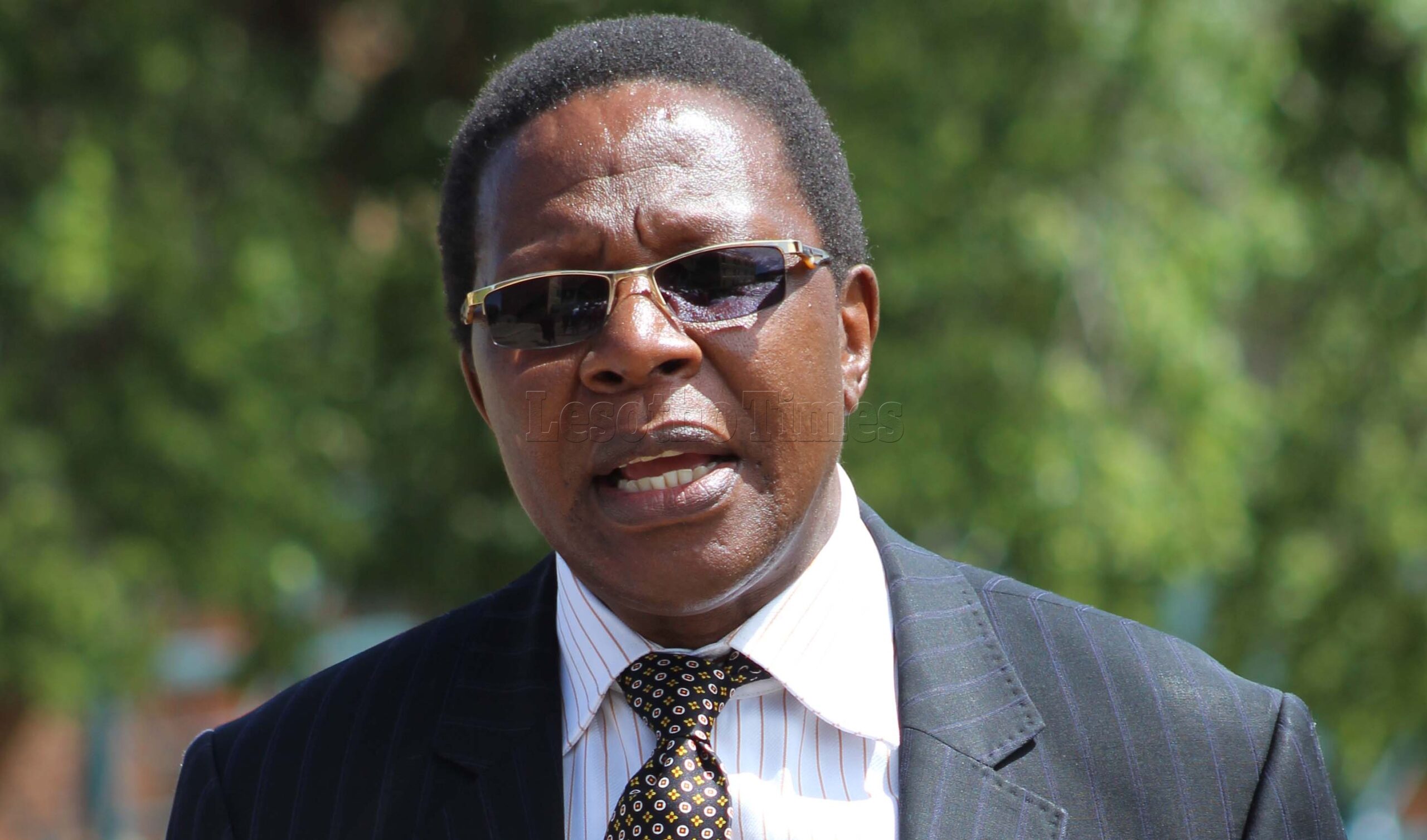
THE leader of the Basotho Action Party (BAP), Professor Nqosa Mahao, has strongly condemned Prime Minister Sam Matekane and members of the 11th Parliament for dodging parliamentary sittings. He said some MPs have been absent for over a year, yet continue to draw their salaries.
Speaking at a press conference at Mafube House in Maseru yesterday, Prof Mahao said parliament is the last line of accountability through its oversight role, but questioned who holds parliament itself accountable.
“We have a Prime Minister who rarely attends parliament, yet one of his main duties is to respond to MPs in the House. On 28 October, he completed three years as Prime Minister but has never addressed parliament. He undermines parliament by failing to attend as both a member and a leader,” Prof Mahao said.
He accused Matekane and his cabinet of disregarding parliamentary processes, noting that when committees submitted reports for tabling, the Prime Minister asked political party leaders for time to assess the reports and their findings — a request they granted in good faith.
“It is now November, and he has yet to bring the reports back to parliament. Had we disagreed, the budget might not have passed, and public servants would have gone unpaid.”
Prof Mahao criticised the broader parliamentary management system, saying it allows MPs to earn full salaries despite skipping sittings.
“This is unreasonable — earning without working amounts to public theft. In any labour setting, it’s ‘no work, no pay’, yet our parliamentary system fails us,” he said, adding that even the Deputy Speaker’s (Tšepang Tšita-Mosena) threat to withhold sitting allowances has been ineffective.
He said some MPs publicly announce they will not attend sittings but continue to earn their salaries while managing their private businesses.
He added that they had requested a review of the appointment of Malichaba Lekhoaba as Chief Executive Officer of the Land Administration Authority (LAA) — a matter that he said also remained unresolved.
Parliamentarians had argued she was underqualified for the post.
With two years left before parliament is dissolved, Prof Mahao warned that the government still had crucial tasks to complete, including passing the national budget and advancing the national reforms agenda.
“The Prime Minister and his cabinet continue to show disregard for political party leaders.”
Turning to corruption, Prof Mahao said the BAP left government due to rampant corruption, which has now become institutional.
“Today, even within the RFP, more than 20 of its own MPs are accusing the government of corruption. While past administrations had individuals accused of corruption, what we are seeing today is institutional looting at the highest level.”
He cited a recent case in which the government allegedly ordered the Lesotho National Development Corporation (LNDC) to disregard its regulations to grant M10 million to Duty Free Sourcing, a company linked to the Revolution For Prosperity (RFP) Chairperson, Teboho Kobeli, though it did not meet loan requirements.
“We also saw the formation of the Government Asset Recovery Task Team (GARTT) to recover stolen state property. After three years of investigations, the Public Accounts Committee (PAC) was informed of ministerial interference — including by Deputy Prime Minister Nthomeng Majara,” he said.
He claimed that when GARTT continued its investigations, it discovered that Mr Matekane’s MGC Park was built on public land, hence it (GARTT) was dissolved. He disagreed with this conclusion, arguing that the Attorney General, who sits in cabinet to provide legal advice, would have prevented such illegality.
Prof Mahao further accused Deputy Prime Minister Majara of interfering with judicial processes.
“She approached the Director of Public Prosecutions (DPP) Hlalefang Motinyane to drop high-profile cases involving some cabinet ministers. When she refused, the cases were suspended despite being before court,” he alleged.
He also cited the dismissal of the former Director General of the Directorate on Corruption and Economic Offences (DCEO), saying it occurred after he attempted to arrest corrupt ministers.
“Last week, Revenue Services Lesotho Commissioner General, Mathabo Mokoko, faced a similar ordeal after asking the Public Accounts Committee to intervene when the Minister of Finance, Retšelisitsoe Matlanyane, ordered her to illegally disclose clients’ records. She was dismissed even though the matter is before court — in total defiance of the rule of law,” Prof Mahao said.
He warned that such conduct undermines good governance and paves the way for dictatorship.
“We are heading towards a dictatorship. We must all work to ensure free and fair elections. We don’t want a situation like the one in Tanzania, where a dictator wins elections with 98 percent,” he warned, appealing to civil society organisations, churches, the media, and international bodies to safeguard democracy.
Meanwhile, Government Spokesperson, Thabo Sekonyela, dismissed Prof Mahao’s claims that the government is undermining the rule of law.
He said Prof Mahao’s comments were premature and speculative.
“He gives good advice, but he knows the miracle elections — he benefited from such in the past. We were not born yesterday; we were alive when his predecessors won rigged elections,” Mr Sekonyela said.
Responding to the allegations of defying court orders, Mr Sekonyela said it would indeed be regrettable if the government were to disregard the courts.
“On that point, we agree. But we disagree with Prof Mahao’s conclusion that the matter is already decided. These issues are still in motion; it’s premature to conclude that the government is defying the courts. What he should say is that people must wait and see whether these court orders will be executed as mandated.”
Regarding corruption, Mr Sekonyela said Prof Mahao should first question his own role as part of the oversight mechanism that helped establish the GARTT.
“He should admit that, as oversight, they allowed the formation of a body that is not legally protected. Instead, he speaks like a layperson,” Mr Sekonyela said.
