
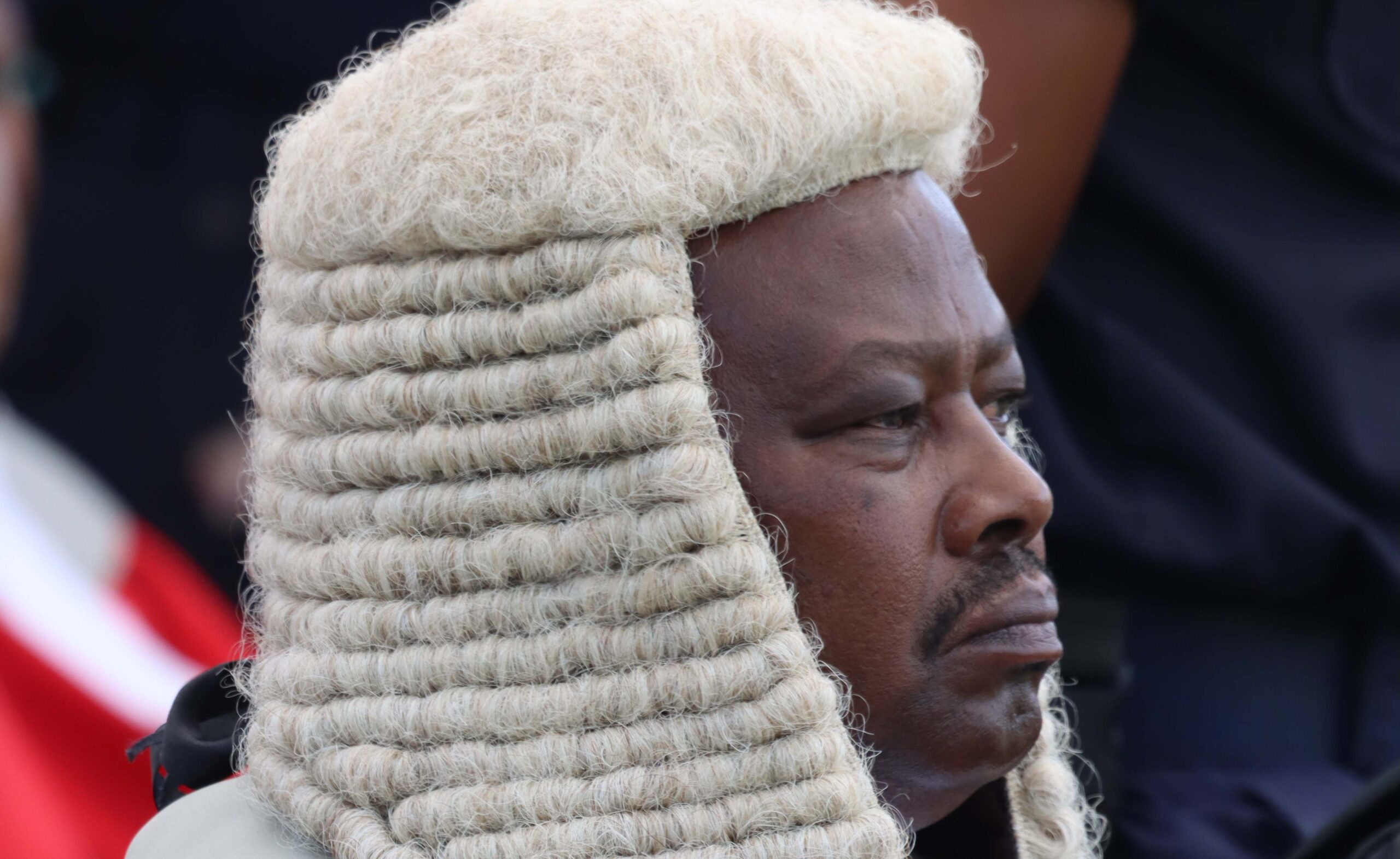
. . . as retired Justice Monapathi sues Chief Justice
. . . describes treatment as “forced labour”
Moorosi Tsiane
A fierce and unprecedented legal showdown has erupted within the top judiciary, with retired High Court judge, Tšeliso Monapathi, dragging Chief Justice Sakoane Sakoane to the Constitutional Court for allegedly withholding his pension benefits and subjecting him to what he calls “forced labour”.
Justice Monapathi accuses Chief Justice Sakoane of unlawfully tying the release of his retirement benefits to the completion of 128 reserved judgments and 11 part-heard cases. This is the work he left unfinished when he officially retired on 4 August 2024.
According to Justice Monapathi’s founding affidavit, the trouble began on 26 July 2024, just days before his retirement, when he received a letter from Justice Sakoane.
In the letter, Sakoane reminded him of his pending caseload and demanded that he submit a timetable for completing the outstanding judgments, making it clear that his retirement benefits would only be released upon completion of outstanding work.
Justice Monapathi says he reached out to the High Court and Court of Appeal Registrar, ‘Mathato Sekoai, on 26 September 2024, requesting office space, a computer, internet access, court files, and support staff to complete the work but he never received a response.
Now, nearly a year after his retirement, Justice Monapathi says he has yet to receive his pension describing the delay as illegal, inhumane, and unconstitutional, and has approached the Constitutional Court to review and set aside Justice Sakoane’s decision.
Justice Sakoane, Prime Minister Sam Matekane, the Judicial Service Commission, the Defined Contribution Pension Fund, and Attorney General Rapelang Motsieloa are cited as first to fifth respondents in the application.
In an emotionally charged affidavit filed recently, Justice Monapathi says he has been left stranded, stateless in the very judiciary he served for three decades.
He alleges that Justice Sakoane has unlawfully tied his retirement benefits to the completion of 128 reserved judgments and 11 part-heard cases, a condition he describes as illegal, inhumane, and unconstitutional.
“The decision to restrict my privileges while I perform my duties, which are specifically meant to protect my independence, is contrary to Section 118(2) of the Constitution and the entire spirit of Chapter XI which underpins the rule of law,” Justice Monapathi states.
“Section 9(1) and (2) guarantee protection from slavery, servitude and forced labour. As already stated above, the Honourable Chief Justice supposes a situation where he can compel me to work, as I have a duty to do so, and that this can be done without compensation. This is a very dangerous interpretation of the law as he does not mention the extent to which he (arbitrarily) can enforce this interpretation.
“This, for all intents and purposes, suggests that I may be forced to work without compensation. This is the literal definition of slavery. Even if I was to be compensated, I cannot be forced to work, as this would be forced labour. The Constitution envisages circumstances where one may be forced to work, but it would be specifically in terms of a specific law and with a clear enforcement mechanism. Slavery, on the other hand, has no exceptions under the Constitution.”
The retired judge argues that Section 121(2) of Lesotho’s Constitution allows him to continue in office voluntarily to complete cases pending before him but does not give anyone the authority to compel him to do so, especially not without the full protections, benefits, and dignity of judicial office.
“The interpretation of Section 121(2) of the Constitution as a punitive clause on judges goes against the entire essence of the Constitution as well as Chapter XI. This interpretation presupposes forced labour upon a judge of the High Court when they retire or resign.
“The very Constitution is being interpreted against itself as it prohibits both slavery and forced labour. To refuse to remunerate me while expecting me to work without the necessary tools, while imposing a sanction upon me, is akin to slavery.
“Judges are not appointed on a contract basis where there are a stipulated number of cases they must complete during their tenure such that the said contract can suddenly be enforced when they retire.
“The power to withhold my benefits is vested in the Public Service Commission in terms of Section 151 of the Constitution. The Public Service Commission cannot withhold my benefits unless I have been removed from office due to misconduct. My retirement benefits are due and payable to me upon my retirement; there is no authority vested with the power to halt the processing of my retirement benefits. The Constitution states that I automatically retire upon the attainment of the prescribed age; having so done, I am entitled to my benefits.
“Furthermore, the Chief Justice cannot refuse to release my terminal benefits when he has not made it possible for me to execute my duties, while also resting the release of my benefits on my completion of the said duties,” argues Justice Monapathi.
He warns that what is happening to him is not just a personal attack but a threat to the very soul of Lesotho’s justice system.
Justice Monapathi accuses Justice Sakoane of distorting the Constitution to support what he describes as judicial coercion. He says the decision is not only unlawful but also violates Section 118(2) of the Constitution, which guarantees judicial independence free from interference.
He therefore wants the court to review and set aside Justice Sakoane’s decision to withhold his benefits. He wants the court to declare that the Chief Justice’s decision to withhold processing of his privileges and benefits until he has completed his judicial duties is contrary to Section 118(2) of the Constitution in that it interferes with his independence as a judge of the High Court.
He further wants the decision to be declared unconstitutional and the court to order that he be granted all the privileges of the office of a puisne judge pending completion of the matters before him.
Justice Sakoane is yet to file his answering papers. The matter is scheduled to be heard on 11 August 2025.
