
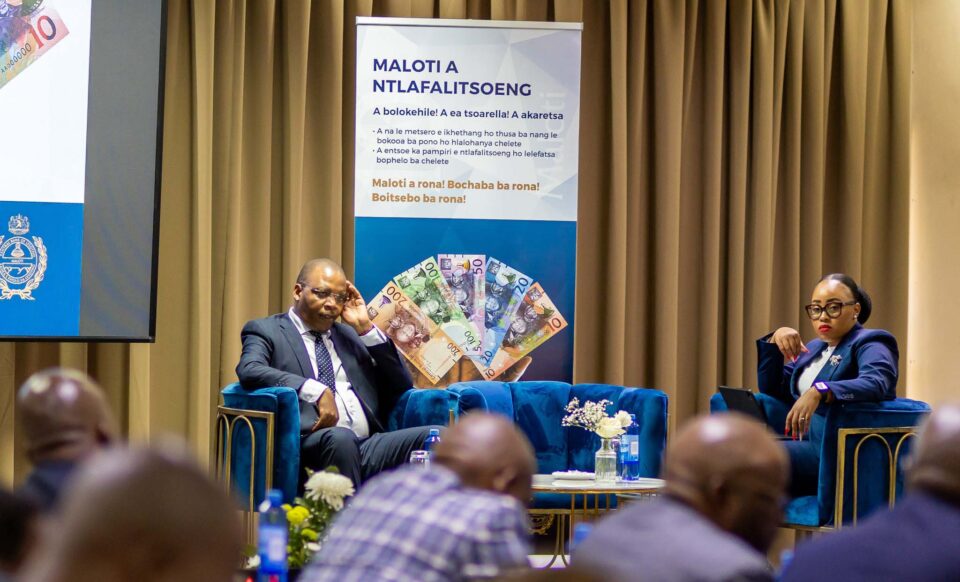
…upgrades bills to curb counterfeit threats
Moroke Sekoboto
THE Central Bank of Lesotho (CBL) has upgraded the Maloti banknotes to enhance security features, modernise the design, improve durability, align the currency with global cash-management standards, promote inclusivity, and preserve national heritage.
CBL Governor, Dr Maluke Letete, launched the new family of the national currency at the Lehakoe Recreational and Cultural Centre this week. This sixth series follows previous issues introduced in 1979, 1989, 1994, 2010, and 2021.
Dr Letete said the upgrade is more than a design change; it is a reaffirmation of the bank’s commitment to security, stability, and trust in the monetary system.
He outlined three fundamental reasons for the introduction of the new banknotes.
The first is enhanced security.
In an era of rapidly advancing technology, he said counterfeit threats continue to evolve.
“Our new currency incorporates state-of-the-art security features, including advanced watermarks, colour-shifting inks, elements for visually impaired individuals, and machine-readable features for the banking system. These measures ensure that our currency remains secure, credible, and protects both consumers and businesses,” Dr Letete said.
The second reason is durability and efficiency.
“The upgraded notes are designed with improved materials and printing techniques, extending their lifespan and reducing replacement costs. This cost-saving measure benefits not only CBL but the entire economy.”
He said the third reason relates to identity and inclusivity, noting that the currency reflects national pride by showcasing symbols that resonate with Lesotho’s cultural identity.
The upgrades also include features that make the notes more accessible to people with visual impairments.
“Showcasing important national symbols such as the portrait of the Kings, representing national unity, and the Mokorotlo hat, which embodies Lesotho’s rich heritage, is crucial. Advanced security features enhance counterfeit deterrence and maintain public trust and confidence in the national currency,” he said.
He emphasised that currency is more than a medium of exchange; it is a symbol of sovereignty and stability.
“By upgrading our currency, we have strengthened confidence in our financial system, which is essential for investment, trade, and economic growth. These initiatives align with our broader strategy to modernise our payment systems, promote financial inclusion, and support digital transformation.”
He added that inclusivity is also promoted by incorporating distinct tactile lines and raised print, enabling visually impaired individuals to easily identify different denominations.
Dr Letete further noted that previous families of Maloti banknotes will remain legal tender and continue circulating alongside the new series until the bank officially withdraws them through a legal notice.
“This upgrade is part of our larger vision for digital payment expansion. As we modernise physical currency, we are also accelerating efforts towards cashless transactions, which help us fight corruption, crime, among other challenges,” he said.
Among others, the features of the upgraded 6th series Maloti currency banknotes include the printing of the M50, M100, and M200 denominations on a hybrid composite substrate that combines the resilience of polyester with the familiar texture of cotton, resulting in a longer circulation lifespan.
Although the M10 and M20 have retained the traditional cotton substrate, they are now reinforced with a sisal thread to enhance their strength and durability in circulation.
He added that the upgraded series also offers improved security through the addition of advanced security threads.
“The higher denominations (M50, M100, and M200) feature a RollingStar security thread that displays dynamic light and colour effects, shifting between the letters ‘CBL’ and the banknote’s denomination when tilted.
“The lower denominations (M10 and M20) contain the Anima thread, which appears as a broken line but becomes continuous when viewed against the light. This provides a refined and easily identifiable security layer against counterfeiting.”
Switching from cotton paper to a composite (hybrid) substrate for the higher denominations improves durability, reduces replacement costs, and enhances performance across varying climatic conditions.
CBL First Deputy Governor, Lehlomela Mohapi, explained that the Central Bank of Lesotho (CBL) has four core areas of operation, each differing in scope.
He said the CBL acts as the banker and adviser to the government, serves as an economic and financial adviser, and functions as the regulator and supervisor of the financial sector.
“CBL is the protector of the Basotho nation — an agent of trust. The fourth area of responsibility is the responsibility it has to itself; it has to ensure that it is a well-governed and competent institution,” Mr Mohapi said.
He added that the banknotes were reviewed to stay ahead of counterfeit threats and to meet emerging environmental standards, noting that the composition of the currency must align with modern sustainability principles.
“There are considerations of inclusivity, as the banknotes must cater for visually impaired people. Today’s launch is a reaffirmation of our commitment to ensuring that every Mosotho, and everyone within the borders of Lesotho, transacts with a currency they can trust and that is secure,” Mr Mohapi said.
